








Few expected India vs Japan to become such a big talking point in international cricket.
India were the world champions. Japan were ranked 41st in the men’s T20I rankings and were playing against a Full Member for the first time. On paper, India looked much stronger than Japan.
But rain changed everything at the Sano International Cricket Ground. It turned the historic match into a five-over contest and made the difference between the two teams look much smaller.
Japan took India all the way to the final over. Then, one umpiring decision completely changed the match’s mood.
An umpire called a wide. Indian players protested against the decision. The two umpires then spoke to each other and changed the call.
Soon, people started accusing India of “bullying” the umpires. However, the situation was not as simple as it first looked.
So, what really happened in the India vs Japan T20I, why did the umpire cancel the wide, and were the officials allowed to change the decision?
India vs Japan turns into a five-over thriller
Rain changed the match before it even started.
Officials reduced the one-off T20I to only five overs per side, giving both teams little room for mistakes. India captain Shreyas Iyer won the toss and chose to bat first, but Japan quickly put India under pressure.
Charlie Hara-Hinze gave Japan a great start. He dismissed Abhishek Sharma in the first over and then removed Ishan Kishan. India also struggled to score quickly on the slow pitch.
Iyer fought back with 16 from 12 balls and helped India reach only 32-4 from five overs.
Japan needed just 33 runs to win. Playing their first men’s international against a Full Member nation, Japan suddenly had a real chance to beat the world champions.
Japan refused to let India escape easily
India started their bowling innings with spin.
Axar Patel opened the bowling and dismissed Lachlan Yamamoto-Lake with his fourth ball. Washington Sundar then took another wicket in the second over as India tried to take control.
But Japan kept fighting.
Their captain Kendel Kadowaki-Fleming scored 12 before India dismissed him. Japan still kept scoring enough runs to stay in the chase.
After four overs, the situation was very clear.
Japan needed eight runs from the final six balls, and they still had seven wickets left.
India gave Axar the job of defending those runs.
What happened next turned a close match into a major cricket debate.
The India vs Japan controversy begins in the final over
Axar started the final over with a dot ball and then gave away one run.
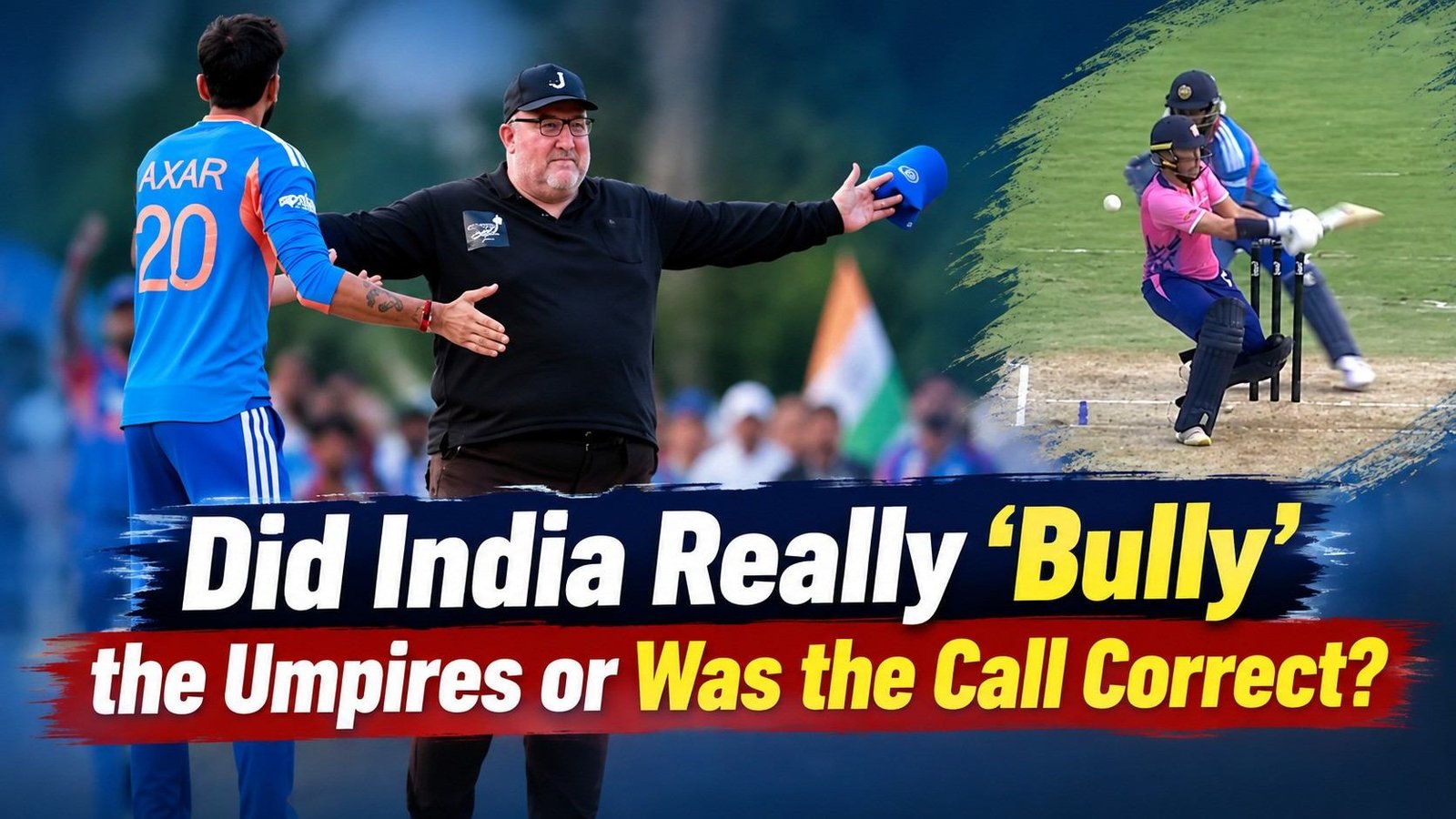
His next ball went down the leg side, and the umpire called it a wide.
That brought Japan even closer to the target.
Then came the ball that became the biggest talking point after the match.
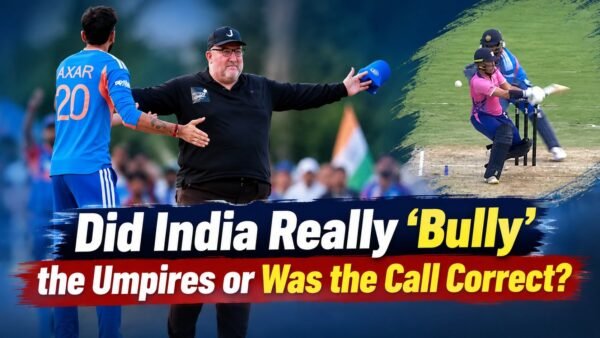
Axar bowled around the wicket to left-handed Alexander Shirai-Patmore. The batter tried to play a reverse sweep. The ball went down what would normally have been the batter’s leg side. Umpire Chris Thurgate first signalled a wide.
The Indian players quickly protested against the call.
Axar and wicketkeeper Sanju Samson showed that they were unhappy with the decision. Captain Shreyas Iyer also went to speak with the other on-field umpire, Chris Brown.
Brown and Thurgate then spoke about the decision.
After that discussion, the umpires did something unusual.
They cancelled the wide.
The ball became a dot ball.
There was no DRS review, and the officials did not appear to use a replay before changing the decision.
That immediately started the controversy.
ALSO READ: Nasser Al-Khelaifi Faces Fresh Questions as PSG and beIN Roles Come Under Scrutiny
Who were the umpires in India vs Japan?
The two on-field officials were Chris Thurgate of Japan and Chris Brown of New Zealand.
Thurgate stood at the bowler’s end and made the first wide call. Brown stood at the striker’s end.
After the Indian players questioned the call, the two umpires spoke to each other. Thurgate then changed his original decision.
The timing made the situation even more important.
Japan were close to producing one of the biggest surprises in international cricket. India, meanwhile, were trying to avoid a defeat against a team ranked far below them.
So, when the umpire changed his decision after India’s protest, it naturally attracted a lot of attention.
Why were India accused of ‘bullying’ the umpires?
People were not only debating whether the ball was actually a wide.
They were also questioning how the decision changed.
India did not have a formal player review. The umpires also did not appear to check a television replay. Instead, they changed the decision after Axar, Samson and Iyer showed that they disagreed with the original call.
This made some people question whether the Indian players had put pressure on the umpires.
Wisden writer Ben Gardner strongly criticised the incident.
“With five off four needed for the biggest upset in cricket history, India have just bullied the umpires into overturning a wide call against Japan.”
His reaction showed the main concern. India are one of cricket’s biggest teams, and the players protested before the umpire changed a very important decision.
Gardner then added:
“Genuinely disgraceful.”
The comments quickly gained attention because Japan were only a few runs away from a historic win.
However, there was another important part of the debate.
The wide-ball rule was not as simple as it looked.
Was Axar Patel’s delivery actually a wide?
This is where the India vs Japan wide controversy becomes more interesting.
Shirai-Patmore tried to play a reverse sweep.
That is important because the rules for wides can change when a batter tries, prepares to play or gets into position for a reverse sweep or switch hit.
The guidance states:
“A batter attempts or shapes to play a reverse sweep or switch hit. In this instance, the wide guidelines will be applicable to both leg-side and off-side.”
Normally, umpires follow strict rules for balls that go down the leg side in limited-overs cricket.
However, the situation changes when the batter changes his position to play a reverse sweep or switch hit.
The guidance further explains:
“Consequently, in these circumstances, 75cm wide guideline used in ODIs and T20Is shall apply on the off-side and the leg-side.”
In very simple terms, when a batter tries a reverse sweep, the normal protection for a ball going past the leg stump can change.
That makes a big difference when looking at this particular delivery.
Former ICC umpire explains why it was not a wide
View this post on Instagram
Former ICC international panel umpire Anil Chaudhary supported the final decision. He explained why Shirai-Patmore’s reverse sweep was important.
“The umpire can give an opinion call. In this instance I can say once you are playing reverse or switch hit, it is the same thing. Both sides become offside.”
According to his explanation, the umpire should not judge the ball like a normal delivery going down the leg side.
The reverse-sweep attempt changed how the wide rule applied to the batter.
Chaudhary also supported the final call:
“It is there in the ICC Almanac. It was not a wide ball. Chris Brown (the umpire at the striker’s end) is a good ICC umpire. I think he managed somehow and spoke to the other umpire. And ultimately, they corrected it.”
This creates an important difference in the debate.
There are two separate questions here.
Was the final decision technically correct?
And did India challenge the original decision in the right way?
The answers to those two questions may not be the same.
Could the umpire legally reverse his decision?
Another big question was whether Thurgate had the right to change his original decision.
Some people believed that once he had called a wide, he could not change it.
However, an umpire can correct a decision before play continues, depending on the playing conditions.
Chaudhary explained:
“Sometimes the umpires look at the senior partner who is seasoned, who understands all the playing conditions. Maybe they agreed before the match to consult.”
Thurgate spoke with Brown before the next ball started.
According to Chaudhary, the umpires still had time to change the decision.
“So, unless the next ball comes into play, or they call time, they can do it. That is the provision.”
The next ball had not started, and the umpires had not called time.
So, they still had the chance to change the decision.
Chaudhary added:
“They can do it. The umpire can revoke any time, unless the next ball has come into play or they have called time. They didn’t call time. The match was not stopped. And the next ball, the run-up didn’t even start. Ultimately, it is about the correct call.”
This makes the controversy more complicated than it first looked on social media.
But did India’s protest influence the umpires?
The rules cannot fully answer this question.
The final decision may have been correct under the playing conditions. However, people outside the match officials cannot know exactly why Thurgate changed his decision.
Did India’s protest put pressure on him?
Or did Brown simply explain the reverse-sweep wide rule to him?
Chaudhary also pointed out this difference.
“That is a different thing, yeah. Coming under pressure and doing this is a different thing. He (Thurgate) thought, let me speak to the other guy.”
This is one of the most important parts of the debate.
A correct final decision does not automatically answer questions about how the officials reached that decision.
At the same time, India’s protest does not prove that the players bullied the umpires into making a wrong call.
What we know is that the two officials spoke before the next ball. They then reached a decision that Chaudhary believes was correct under the playing conditions.
ALSO READ: Chennai Super Kings make big coaching move ahead of IPL 2027, brings this Indian legend to CSK
Even the previous delivery created an interesting question
Another small detail did not receive as much attention.
Shirai-Patmore also tried a reverse sweep on the previous ball, which the umpire called a wide.
Based on Chaudhary’s explanation, there is an argument that the normal leg-side wide rule should not have applied to that delivery either.
That makes the final over even more interesting.
Instead of simply giving India an unfair advantage, the umpires may have corrected the way they had judged a similar delivery just moments earlier.
That does not remove questions about the reaction of the Indian players.
However, it gives more context to claims that the final decision was simply wrong.
How important was the overturned call?
It was extremely important.
Japan were chasing only 33 runs in five overs, so every run and every ball mattered.
After the umpires changed the disputed call, Shirai-Patmore took one run from the next ball.
Japan then failed to hit the boundary they needed from the remaining deliveries.
They finished on 30-3, which gave India a two-run victory.
The scorecard therefore reads:
India 32-4 beat Japan 30-3 by two runs. You can check the full scoreboard of this match HERE.
However, the scorecard does not fully show how close India came to suffering one of international cricket’s biggest surprise defeats.
ALSO READ: Is Cricket’s Global Expansion Coming at the Cost of Quality?
Shreyas Iyer praises Japan after narrow escape
Interestingly, neither captain focused on the umpiring controversy immediately after the match.
Instead, Iyer spoke about how difficult the game had been.
“Honestly speaking, it was a very difficult wicket to bat on. A five-over game, it can go anywhere. It doesn’t matter how good a team you are.”
His comments showed how unpredictable a five-over match can be. Just a few balls can completely change the game.
Iyer also praised Japan.
“The attitude and approach the Japanese team showed today was impeccable, and kudos to them. Their approach was outstanding. I’m sure that they are on the right track.”
Japan deserved that praise because there was a huge difference in experience between the two teams.
Japan did not simply compete against India. They pushed the world champions until the final moments of the game.
Japan captain sees a bigger meaning behind the result
For Japan, the defeat was still an important step forward.
Kadowaki-Fleming said the players had strong emotions after coming so close to a huge win.
“Emotions are running pretty high in our group. But the fact that we’re able to run the best team in the world, in my opinion, to the last ball of a game is pretty special.”
Japan started the match as huge outsiders. By the end, they were thinking about how close they had come to a historic victory.
Their captain also spoke about the importance of the occasion:
“I think today was a really momentous occasion in that it was the first time we were able to face a full member.”
The umpiring debate should not make people forget this part of the story.
Japan are an ICC Associate nation with only around 7,300 registered players and 16 cricket grounds. Playing against India was already a major moment for cricket in Japan.
Coming so close to beating them made the occasion even more special.
ALSO READ: Gianni Infantino Makes Major FIFA Move After Weeks of Pressure—but What Could Change Now?
Why was India playing Japan in the first place?
The match was about more than preparing for the Asian Games.
The Japan Cricket Association had worked for a long time to bring a major cricket nation to Japan. The match was also connected to the wider relationship between India and Japan.
JCA chief executive Naoki Alex Miyaji had already said that one match would not suddenly make cricket as popular as Japan’s biggest sports.
“One match or competition itself won’t change anything, and we are certainly not going to think that suddenly it’s going to be as popular as baseball or football in Japan.”
However, he saw the India match as the beginning of something bigger.
“But the match against India is the first page of a new era.”
Very few people could have expected that first page to become so dramatic.
India vs Japan produced more than just a controversy
The India vs Japan T20I will likely be remembered mainly for the overturned wide.
However, focusing only on that decision would ignore what Japan achieved in the match.
They restricted one of cricket’s strongest teams to 32-4. They dismissed experienced Indian batters. They stayed calm while chasing a small target on a difficult pitch. They also entered the final over needing only eight runs to beat the world champions.
The umpiring controversy also needs a closer look.
Indian players protested, and the umpire then changed his decision. That naturally raised questions about pressure and player behaviour. Those questions may continue because people outside the officials cannot know exactly why the umpire changed his mind.
However, the technical part of the situation is clearer.
Shirai-Patmore tried a reverse sweep, so the normal leg-side wide rule did not apply in the usual way. Former international umpire Anil Chaudhary believes the officials finally made the correct decision. He also explained that they could change the call because the next ball had not started.
So, the biggest question from Sano may not simply be whether the final call was right or wrong.
The bigger question is whether people will ever separate the final decision from the heated protest that happened before the officials changed it.
What do you think? Could the same decision have caused such debate if India had never protested to the umpires? Let us know in the comments.
Keep following Sportschilly for the latest updates.