











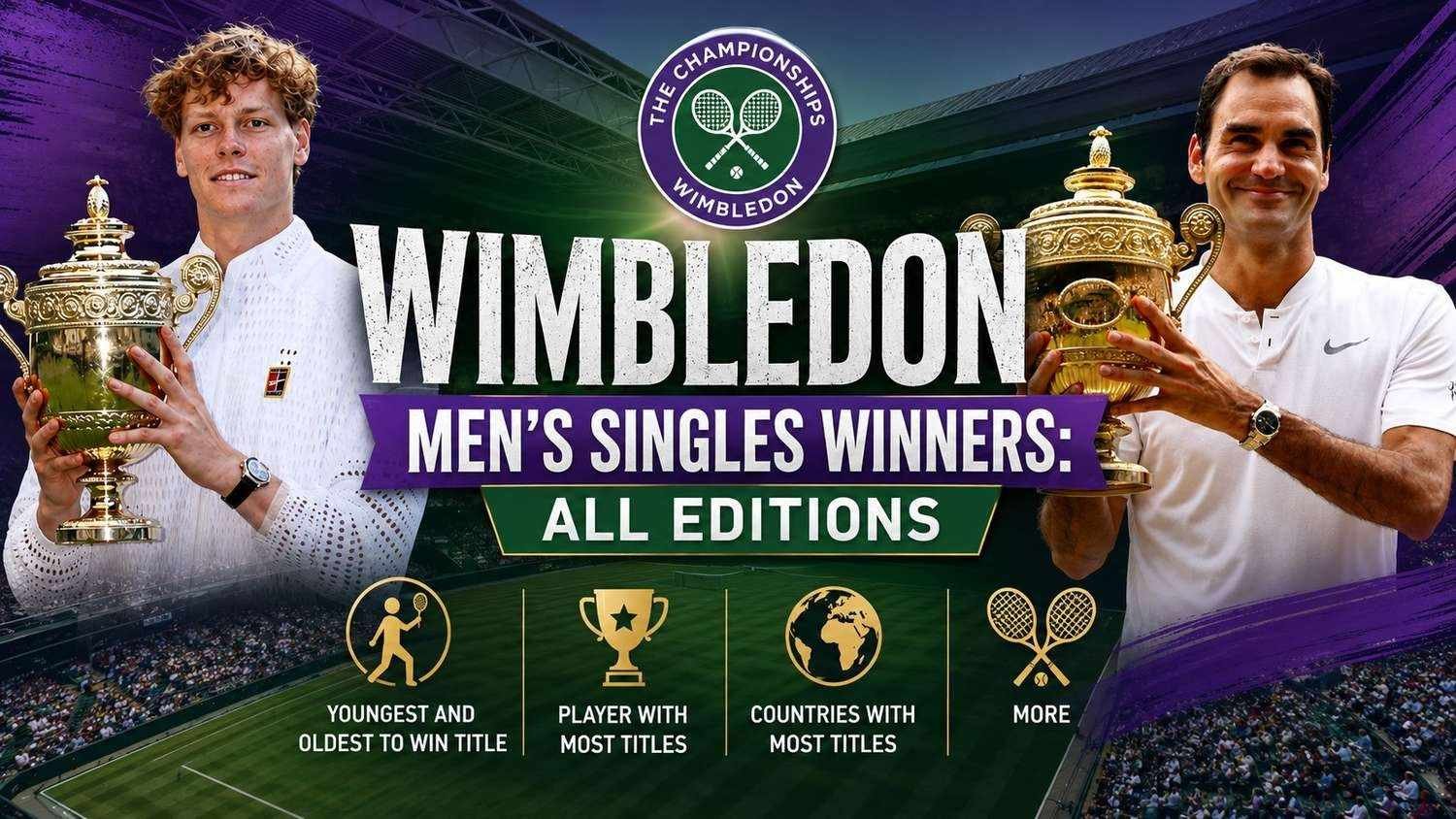
Wimbledon is much more than a tennis tournament. It takes place on the famous grass courts in London. The Championships have seen many great champions, famous rivalries, and amazing records.
The first men’s singles event took place in 1877. Since then, many generations of players have competed for one of the biggest trophies in tennis.
As of 2026, a total of 139 editions have been completed. However, Wimbledon stopped during the two World Wars, and it also cancelled the 2020 tournament due to the COVID-19 pandemic. .
Today, we will see the list of Wimbledon Men’s Singles champions.
Wimbledon Men’s Singles Champions Amateur Era (1877 – 1967)
Here are all the winners in the Amateur Era.
| Year | Winner (Country) | Runner-up (Country) | Final Score |
| 1877 | Spencer Gore (United Kingdom) | William Marshall (United Kingdom) | 6–1, 6–2, 6–4 |
| 1878 | Frank Hadow (United Kingdom) | Spencer Gore (United Kingdom) | 7–5, 6–1, 9–7 |
| 1879 | John Hartley (United Kingdom) | Vere St. Leger Goold (United Kingdom) | 6–2, 6–4, 6–2 |
| 1880 | John Hartley (United Kingdom) | Herbert Lawford (United Kingdom) | 6–3, 6–2, 2–6, 6–3 |
| 1881 | William Renshaw (United Kingdom) | John Hartley (United Kingdom) | 6–0, 6–1, 6–1 |
| 1882 | William Renshaw (United Kingdom) | Ernest Renshaw (United Kingdom) | 6–1, 2–6, 4–6, 6–2, 6–2 |
| 1883 | William Renshaw (United Kingdom) | Ernest Renshaw (United Kingdom) | 2–6, 6–3, 6–3, 4–6, 6–3 |
| 1884 | William Renshaw (United Kingdom) | Herbert Lawford (United Kingdom) | 6–0, 6–4, 9–7 |
| 1885 | William Renshaw (United Kingdom) | Herbert Lawford (United Kingdom) | 7–5, 6–2, 4–6, 7–5 |
| 1886 | William Renshaw (United Kingdom) | Herbert Lawford (United Kingdom) | 6–0, 5–7, 6–3, 6–4 |
| 1887 | Herbert Lawford (United Kingdom) | Ernest Renshaw (United Kingdom) | 1–6, 6–3, 3–6, 6–4, 6–4 |
| 1888 | Ernest Renshaw (United Kingdom) | Herbert Lawford (United Kingdom) | 6–3, 7–5, 6–0 |
| 1889 | William Renshaw (United Kingdom) | Ernest Renshaw (United Kingdom) | 6–4, 6–1, 3–6, 6–0 |
| 1890 | Willoughby Hamilton (United Kingdom) | William Renshaw (United Kingdom) | 6–8, 6–2, 3–6, 6–1, 6–1 |
| 1891 | Wilfred Baddeley (United Kingdom) | Joshua Pim (United Kingdom) | 6–4, 1–6, 7–5, 6–0 |
| 1892 | Wilfred Baddeley (United Kingdom) | Joshua Pim (United Kingdom) | 4–6, 6–3, 6–3, 6–2 |
| 1893 | Joshua Pim (United Kingdom) | Wilfred Baddeley (United Kingdom) | 3–6, 6–1, 6–3, 6–2 |
| 1894 | Joshua Pim (United Kingdom) | Wilfred Baddeley (United Kingdom) | 10–8, 6–2, 8–6 |
| 1895 | Wilfred Baddeley (United Kingdom) | Wilberforce Eaves (United Kingdom) | 4–6, 2–6, 8–6, 6–2, 6–3 |
| 1896 | Harold Mahony (United Kingdom) | Wilfred Baddeley (United Kingdom) | 6–2, 6–8, 5–7, 8–6, 6–3 |
| 1897 | Reginald Doherty (United Kingdom) | Harold Mahony (United Kingdom) | 6–4, 6–4, 6–3 |
| 1898 | Reginald Doherty (United Kingdom) | Laurence Doherty (United Kingdom) | 6–3, 6–3, 2–6, 5–7, 6–1 |
| 1899 | Reginald Doherty (United Kingdom) | Arthur Gore (United Kingdom) | 1–6, 4–6, 6–3, 6–3, 6–3 |
| 1900 | Reginald Doherty (United Kingdom) | Sydney Smith (United Kingdom) | 6–8, 6–3, 6–1, 6–2 |
| 1901 | Arthur Gore (United Kingdom) | Reginald Doherty (United Kingdom) | 4–6, 7–5, 6–4, 6–4 |
| 1902 | Laurence Doherty (United Kingdom) | Arthur Gore (United Kingdom) | 6–4, 6–3, 3–6, 6–0 |
| 1903 | Laurence Doherty (United Kingdom) | Frank Riseley (United Kingdom) | 7–5, 6–3, 6–0 |
| 1904 | Laurence Doherty (United Kingdom) | Frank Riseley (United Kingdom) | 6–1, 7–5, 8–6 |
| 1905 | Laurence Doherty (United Kingdom) | Norman Brookes (Australia) | 8–6, 6–2, 6–4 |
| 1906 | Laurence Doherty (United Kingdom) | Frank Riseley (United Kingdom) | 6–4, 4–6, 6–2, 6–3 |
| 1907 | Norman Brookes (Australia) | Arthur Gore (United Kingdom) | 6–4, 6–2, 6–2 |
| 1908 | Arthur Gore (United Kingdom) | Herbert Roper Barrett (United Kingdom) | 6–3, 6–2, 4–6, 3–6, 6–4 |
| 1909 | Arthur Gore (United Kingdom) | Major Ritchie (United Kingdom) | 6–8, 1–6, 6–2, 6–2, 6–2 |
| 1910 | Anthony Wilding (New Zealand) | Arthur Gore (United Kingdom) | 6–4, 7–5, 4–6, 6–2 |
| 1911 | Anthony Wilding (New Zealand) | Herbert Roper Barrett (United Kingdom) | 6–4, 4–6, 2–6, 6–2, Retired |
| 1912 | Anthony Wilding (New Zealand) | Arthur Gore (United Kingdom) | 6–4, 6–4, 4–6, 6–4 |
| 1913 | Anthony Wilding (New Zealand) | Maurice McLoughlin (United States) | 8–6, 6–3, 10–8 |
| 1914 | Norman Brookes (Australia) | Anthony Wilding (New Zealand) | 6–4, 6–4, 7–5 |
| 1915 | No competition | — | — |
| 1916 | No competition | — | — |
| 1917 | No competition | — | — |
| 1918 | No competition | — | — |
| 1919 | Gerald Patterson (Australia) | Norman Brookes (Australia) | 6–3, 7–5, 6–2 |
| 1920 | Bill Tilden (United States) | Gerald Patterson (Australia) | 2–6, 6–3, 6–2, 6–4 |
| 1921 | Bill Tilden (United States) | Brian Norton (South Africa) | 4–6, 2–6, 6–1, 6–0, 7–5 |
| 1922 | Gerald Patterson (Australia) | Randolph Lycett (United Kingdom) | 6–3, 6–4, 6–2 |
| 1923 | Bill Johnston (United States) | Francis Hunter (United States) | 6–0, 6–3, 6–1 |
| 1924 | Jean Borotra (France) | René Lacoste (France) | 6–1, 3–6, 6–1, 3–6, 6–4 |
| 1925 | René Lacoste (France) | Jean Borotra (France) | 6–3, 6–3, 4–6, 8–6 |
| 1926 | Jean Borotra (France) | Howard Kinsey (United States) | 8–6, 6–1, 6–3 |
| 1927 | Henri Cochet (France) | Jean Borotra (France) | 4–6, 4–6, 6–3, 6–4, 7–5 |
| 1928 | René Lacoste (France) | Henri Cochet (France) | 6–1, 4–6, 6–4, 6–2 |
| 1929 | Henri Cochet (France) | Jean Borotra (France) | 6–4, 6–3, 6–4 |
| 1930 | Bill Tilden (United States) | Wilmer Allison (United States) | 6–3, 9–7, 6–4 |
| 1931 | Sidney Wood (United States) | Frank Shields (United States) | Walkover |
| 1932 | Ellsworth Vines (United States) | Bunny Austin (United Kingdom) | 6–4, 6–2, 6–0 |
| 1933 | Jack Crawford (Australia) | Ellsworth Vines (United States) | 4–6, 11–9, 6–2, 2–6, 6–4 |
| 1934 | Fred Perry (United Kingdom) | Jack Crawford (Australia) | 6–3, 6–0, 7–5 |
| 1935 | Fred Perry (United Kingdom) | Gottfried von Cramm (Germany) | 6–2, 6–4, 6–4 |
| 1936 | Fred Perry (United Kingdom) | Gottfried von Cramm (Germany) | 6–1, 6–1, 6–0 |
| 1937 | Don Budge (United States) | Gottfried von Cramm (Germany) | 6–3, 6–4, 6–2 |
| 1938 | Don Budge (United States) | Bunny Austin (United Kingdom) | 6–1, 6–0, 6–3 |
| 1939 | Bobby Riggs (United States) | Elwood Cooke (United States) | 2–6, 8–6, 3–6, 6–3, 6–2 |
| 1940 | No competition | — | — |
| 1941 | No competition | — | — |
| 1942 | No competition | — | — |
| 1943 | No competition | — | — |
| 1944 | No competition | — | — |
| 1945 | No competition | — | — |
| 1946 | Yvon Petra (France) | Geoff Brown (Australia) | 6–2, 6–4, 7–9, 5–7, 6–4 |
| 1947 | Jack Kramer (United States) | Tom Brown (United States) | 6–1, 6–3, 6–2 |
| 1948 | Bob Falkenburg (United States) | John Bromwich (Australia) | 7–5, 0–6, 6–2, 3–6, 7–5 |
| 1949 | Ted Schroeder (United States) | Jaroslav Drobný (Czechoslovakia) | 3–6, 6–0, 6–3, 4–6, 6–4 |
| 1950 | Budge Patty (United States) | Frank Sedgman (Australia) | 6–1, 8–10, 6–2, 6–3 |
| 1951 | Dick Savitt (United States) | Ken McGregor (Australia) | 6–4, 6–4, 6–4 |
| 1952 | Frank Sedgman (Australia) | Jaroslav Drobný (Egypt) | 4–6, 6–2, 6–3, 6–2 |
| 1953 | Vic Seixas (United States) | Kurt Nielsen (Denmark) | 9–7, 6–3, 6–4 |
| 1954 | Jaroslav Drobný (Egypt) | Ken Rosewall (Australia) | 13–11, 4–6, 6–2, 9–7 |
| 1955 | Tony Trabert (United States) | Kurt Nielsen (Denmark) | 6–3, 7–5, 6–1 |
| 1956 | Lew Hoad (Australia) | Ken Rosewall (Australia) | 6–2, 4–6, 7–5, 6–4 |
| 1957 | Lew Hoad (Australia) | Ashley Cooper (Australia) | 6–2, 6–1, 6–2 |
| 1958 | Ashley Cooper (Australia) | Neale Fraser (Australia) | 3–6, 6–3, 6–4, 13–11 |
| 1959 | Alex Olmedo (United States) | Rod Laver (Australia) | 6–4, 6–3, 6–4 |
| 1960 | Neale Fraser (Australia) | Rod Laver (Australia) | 6–4, 3–6, 9–7, 7–5 |
| 1961 | Rod Laver (Australia) | Chuck McKinley (United States) | 6–3, 6–1, 6–4 |
| 1962 | Rod Laver (Australia) | Martin Mulligan (Australia) | 6–2, 6–2, 6–1 |
| 1963 | Chuck McKinley (United States) | Fred Stolle (Australia) | 9–7, 6–1, 6–4 |
| 1964 | Roy Emerson (Australia) | Fred Stolle (Australia) | 6–4, 12–10, 4–6, 6–3 |
| 1965 | Roy Emerson (Australia) | Fred Stolle (Australia) | 6–2, 6–4, 6–4 |
| 1966 | Manuel Santana (Spain) | Dennis Ralston (United States) | 6–4, 11–9, 6–4 |
| 1967 | John Newcombe (Australia) | Wilhelm Bungert (West Germany) | 6–3, 6–1, 6–1 |
ALSO READ: Bangladesh Cricket Team Biggest Moments in Test Cricket (Top 10)
Wimbledon Men’s Singles Champions Open Era (1968 – Present)
Here are the winners in the Open Era till now.
| Year | Winner (Country) | Runner-up (Country) | Score in the Final |
| 1968 | Rod Laver (Australia) | Tony Roche (Australia) | 6–3, 6–4, 6–2 |
| 1969 | Rod Laver (Australia) | John Newcombe (Australia) | 6–4, 5–7, 6–4, 6–4 |
| 1970 | John Newcombe (Australia) | Ken Rosewall (Australia) | 5–7, 6–3, 6–2, 3–6, 6–1 |
| 1971 | John Newcombe (Australia) | Stan Smith (United States) | 6–3, 5–7, 2–6, 6–4, 6–4 |
| 1972 | Stan Smith (United States) | Ilie Năstase (Romania) | 4–6, 6–3, 6–3, 4–6, 7–5 |
| 1973 | Jan Kodeš (Czechoslovakia) | Alex Metreveli (Soviet Union) | 6–1, 9–8(7–5), 6–3 |
| 1974 | Jimmy Connors (United States) | Ken Rosewall (Australia) | 6–1, 6–1, 6–4 |
| 1975 | Arthur Ashe (United States) | Jimmy Connors (United States) | 6–1, 6–1, 5–7, 6–4 |
| 1976 | Björn Borg (Sweden) | Ilie Năstase (Romania) | 6–4, 6–2, 9–7 |
| 1977 | Björn Borg (Sweden) | Jimmy Connors (United States) | 3–6, 6–2, 6–1, 5–7, 6–4 |
| 1978 | Björn Borg (Sweden) | Jimmy Connors (United States) | 6–2, 6–2, 6–3 |
| 1979 | Björn Borg (Sweden) | Roscoe Tanner (United States) | 6–7(4–7), 6–1, 3–6, 6–3, 6–4 |
| 1980 | Björn Borg (Sweden) | John McEnroe (United States) | 1–6, 7–5, 6–3, 6–7(16–18), 8–6 |
| 1981 | John McEnroe (United States) | Björn Borg (Sweden) | 4–6, 7–6(7–1), 7–6(7–4), 6–4 |
| 1982 | Jimmy Connors (United States) | John McEnroe (United States) | 3–6, 6–3, 6–7(2–7), 7–6(7–5), 6–4 |
| 1983 | John McEnroe (United States) | Chris Lewis (New Zealand) | 6–2, 6–2, 6–2 |
| 1984 | John McEnroe (United States) | Jimmy Connors (United States) | 6–1, 6–1, 6–2 |
| 1985 | Boris Becker (West Germany) | Kevin Curren (United States) | 6–3, 6–7(4–7), 7–6(7–3), 6–4 |
| 1986 | Boris Becker (West Germany) | Ivan Lendl (Czechoslovakia) | 6–4, 6–3, 7–5 |
| 1987 | Pat Cash (Australia) | Ivan Lendl (Czechoslovakia) | 7–6(7–5), 6–2, 7–5 |
| 1988 | Stefan Edberg (Sweden) | Boris Becker (West Germany) | 4–6, 7–6(7–2), 6–4, 6–2 |
| 1989 | Boris Becker (West Germany) | Stefan Edberg (Sweden) | 6–0, 7–6(7–1), 6–4 |
| 1990 | Stefan Edberg (Sweden) | Boris Becker (West Germany) | 6–2, 6–2, 3–6, 3–6, 6–4 |
| 1991 | Michael Stich (Germany) | Boris Becker (Germany) | 6–4, 7–6(7–4), 6–4 |
| 1992 | Andre Agassi (United States) | Goran Ivanišević (Croatia) | 6–7(8–10), 6–4, 6–4, 1–6, 6–4 |
| 1993 | Pete Sampras (United States) | Jim Courier (United States) | 7–6(7–3), 7–6(8–6), 3–6, 6–3 |
| 1994 | Pete Sampras (United States) | Goran Ivanišević (Croatia) | 7–6(7–2), 7–6(7–5), 6–0 |
| 1995 | Pete Sampras (United States) | Boris Becker (Germany) | 6–7(5–7), 6–2, 6–4, 6–2 |
| 1996 | Richard Krajicek (Netherlands) | MaliVai Washington (United States) | 6–3, 6–4, 6–3 |
| 1997 | Pete Sampras (United States) | Cédric Pioline (France) | 6–4, 6–2, 6–4 |
| 1998 | Pete Sampras (United States) | Goran Ivanišević (Croatia) | 6–7(2–7), 7–6(11–9), 6–4, 3–6, 6–2 |
| 1999 | Pete Sampras (United States) | Andre Agassi (United States) | 6–3, 6–4, 7–5 |
| 2000 | Pete Sampras (United States) | Patrick Rafter (Australia) | 6–7(10–12), 7–6(7–5), 6–4, 6–2 |
| 2001 | Goran Ivanišević (Croatia) | Patrick Rafter (Australia) | 6–3, 3–6, 6–3, 2–6, 9–7 |
| 2002 | Lleyton Hewitt (Australia) | David Nalbandian (Argentina) | 6–1, 6–3, 6–2 |
| 2003 | Roger Federer (Switzerland) | Mark Philippoussis (Australia) | 7–6(7–5), 6–2, 7–6(7–3) |
| 2004 | Roger Federer (Switzerland) | Andy Roddick (United States) | 4–6, 7–5, 7–6(7–3), 6–4 |
| 2005 | Roger Federer (Switzerland) | Andy Roddick (United States) | 6–2, 7–6(7–2), 6–4 |
| 2006 | Roger Federer (Switzerland) | Rafael Nadal (Spain) | 6–0, 7–6(7–5), 6–7(2–7), 6–3 |
| 2007 | Roger Federer (Switzerland) | Rafael Nadal (Spain) | 7–6(9–7), 4–6, 7–6(7–3), 2–6, 6–2 |
| 2008 | Rafael Nadal (Spain) | Roger Federer (Switzerland) | 6–4, 6–4, 6–7(5–7), 6–7(8–10), 9–7 |
| 2009 | Roger Federer (Switzerland) | Andy Roddick (United States) | 5–7, 7–6(8–6), 7–6(7–5), 3–6, 16–14 |
| 2010 | Rafael Nadal (Spain) | Tomáš Berdych (Czech Republic) | 6–3, 7–5, 6–4 |
| 2011 | Novak Djokovic (Serbia) | Rafael Nadal (Spain) | 6–4, 6–1, 1–6, 6–3 |
| 2012 | Roger Federer (Switzerland) | Andy Murray (United Kingdom) | 4–6, 7–5, 6–3, 6–4 |
| 2013 | Andy Murray (United Kingdom) | Novak Djokovic (Serbia) | 6–4, 7–5, 6–4 |
| 2014 | Novak Djokovic (Serbia) | Roger Federer (Switzerland) | 6–7(7–9), 6–4, 7–6(7–4), 5–7, 6–4 |
| 2015 | Novak Djokovic (Serbia) | Roger Federer (Switzerland) | 7–6(7–1), 6–7(10–12), 6–4, 6–3 |
| 2016 | Andy Murray (United Kingdom) | Milos Raonic (Canada) | 6–4, 7–6(7–3), 7–6(7–2) |
| 2017 | Roger Federer (Switzerland) | Marin Čilić (Croatia) | 6–3, 6–1, 6–4 |
| 2018 | Novak Djokovic (Serbia) | Kevin Anderson (South Africa) | 6–2, 6–2, 7–6(7–3) |
| 2019 | Novak Djokovic (Serbia) | Roger Federer (Switzerland) | 7–6(7–5), 1–6, 7–6(7–4), 4–6, 13–12(7–3) |
| 2020 | No competition | No competition | No competition |
| 2021 | Novak Djokovic (Serbia) | Matteo Berrettini (Italy) | 6–7(4–7), 6–4, 6–4, 6–3 |
| 2022 | Novak Djokovic (Serbia) | Nick Kyrgios (Australia) | 4–6, 6–3, 6–4, 7–6(7–3) |
| 2023 | Carlos Alcaraz (Spain) | Novak Djokovic (Serbia) | 1–6, 7–6(8–6), 6–1, 3–6, 6–4 |
| 2024 | Carlos Alcaraz (Spain) | Novak Djokovic (Serbia) | 6–2, 6–2, 7–6(7–4) |
| 2025 | Jannik Sinner (Italy) | Carlos Alcaraz (Spain) | 4–6, 6–4, 6–4, 6–4 |
| 2026 | Jannik Sinner (Italy) | Alexander Zverev (Germany) | 6–7(7–9), 7–6(7–2), 6–3, 6–4 |
A Brief History of Wimbledon Men’s Singles
The first Wimbledon Championships took place in 1877. The Gentlemen’s Singles was the first event. Spencer Gore became the first champion after beating William Marshall in the final.
In the early years, Wimbledon was very different. It used a Challenge Round system. The defending champion went straight to the final and played the main draw winner. Wimbledon stopped this system after 1921. At that time, only amateur players could compete, as professionals were not allowed.
The Amateur Era: From Spencer Gore to Fred Perry
The Amateur Era had many famous Wimbledon champions. Spencer Gore won the first title in 1877. William Renshaw became the biggest champion of this era, winning seven titles. He won six in a row from 1881 to 1886. However, the old Challenge Round system made his wins easier because he did not play the full tournament each time.
Fred Perry was also a great champion. He won three straight titles from 1934 to 1936. He was the last British man to win Wimbledon until Andy Murray won in 2013. Perry’s final win ended an important period in British Wimbledon history.
The Open Era Begins
A big change came in 1968 when Wimbledon allowed professional players to compete. Rod Laver became the first Open Era champion. He had already won two Wimbledon titles as an amateur.
Laver could not play at Wimbledon from 1963 to 1967 because he had become a professional. At that time, only amateur players could compete. When professionals were allowed in 1968, Laver returned and won the title. He also won again in 1969.
The Open Era brought many great champions, including Borg, McEnroe, Sampras, Federer, Djokovic, Nadal and Murray.
As of 2026, Jannik Sinner is the current champion and has won the title twice, in 2025 and 2026.
Who Has Won the Most Wimbledon Men’s Singles Titles?
| Player | All-time Wimbledon titles |
| Roger Federer | 8 |
| Pete Sampras | 7 |
| Novak Djokovic | 7 |
| William Renshaw | 7 |
| Laurence Doherty | 5 |
The answer depends on the era. In the Amateur Era, William Renshaw holds the record with seven Wimbledon titles. He won six in a row from 1881 to 1886.
In the Open Era, Roger Federer holds the record with eight titles. He won them in 2003, 2004, 2005, 2006, 2007, 2009, 2012 and 2017. Federer played extremely well on grass. His strong serve, quick movement and smart shots made him hard to beat. His five straight titles from 2003 to 2007 also matched Björn Borg’s record from 1976 to 1980.
ALSO READ: Simon Harmer: From Essex to International Success (OPINION)
Roger Federer’s Remarkable Wimbledon Consistency
Federer’s record is even more impressive when we look at his finals. He reached the Wimbledon men’s singles final 12 times, more than any other player. He also reached seven straight finals from 2003 to 2009.
His success shows his great fitness, mental strength and skill on grass. Pete Sampras was also very consistent. From 1993 to 2000, he reached the Wimbledon final seven times in eight years. He won every final he played during that period, showing his incredible dominance on the grass courts.
Most Consecutive Wimbledon Men’s Singles Titles
William Renshaw holds the Amateur Era record with six straight Wimbledon titles from 1881 to 1886.
In the Open Era, Bjorn Borg and Roger Federer share the record with five straight titles. Borg won from 1976 to 1980, while Federer won from 2003 to 2007.
These winning streaks show how hard it is to dominate Wimbledon.
Which Country Has Won the Most Wimbledon Titles?
| Country | Amateur Era | Open Era | All-time |
| Great Britain | 35 | 2 | 37 |
| United States | 18 | 15 | 33 |
| Australia | 15 | 6 | 21 |
| Switzerland | 0 | 8 | 8 |
| France | 7 | 0 | 7 |
Great Britain has produced the most Wimbledon men’s singles champions (37). British players were especially successful during the Amateur Era.
This early success makes sense because Wimbledon started in England, and most early players were British. Over time, the tournament became more international. Players from the United States, Australia, Sweden, Germany, Spain, Switzerland, Serbia, Italy and many other countries have won the title.
Youngest and Oldest Wimbledon Men’s Singles Champions
Boris Becker is the youngest player to win the Wimbledon men’s singles title. He won in 1985 at 17 years and 227 days old. He beat Kevin Curren in the final. Becker won again in 1986 and later won Wimbledon three times.
Arthur Gore is the oldest man to win the title. He was 41 years and 182 days old when he won in 1909.
These records show that both young talent and experience can lead to Wimbledon success.
CONCLUSION
From Spencer Gore’s first win in 1877 to Jannik Sinner’s latest title in 2026, Wimbledon has grown from a small British tennis event into one of the biggest sporting events in the world.
William Renshaw ruled the early years with seven titles. Rod Laver connected the Amateur and Open Eras. Borg, Sampras and Federer later created great periods of success. Federer holds the Open Era record with eight titles and 12 final appearances.
But Wimbledon records can still be broken. What do you think? With young players rising, who will challenge the greatest records next? Let us know in the comments.
Thank you for reading. Keep following Sportschilly for the latest stats and updates.
Read more at Sports Chilly.