

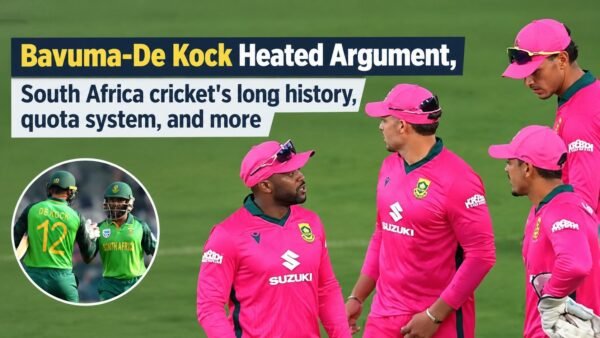









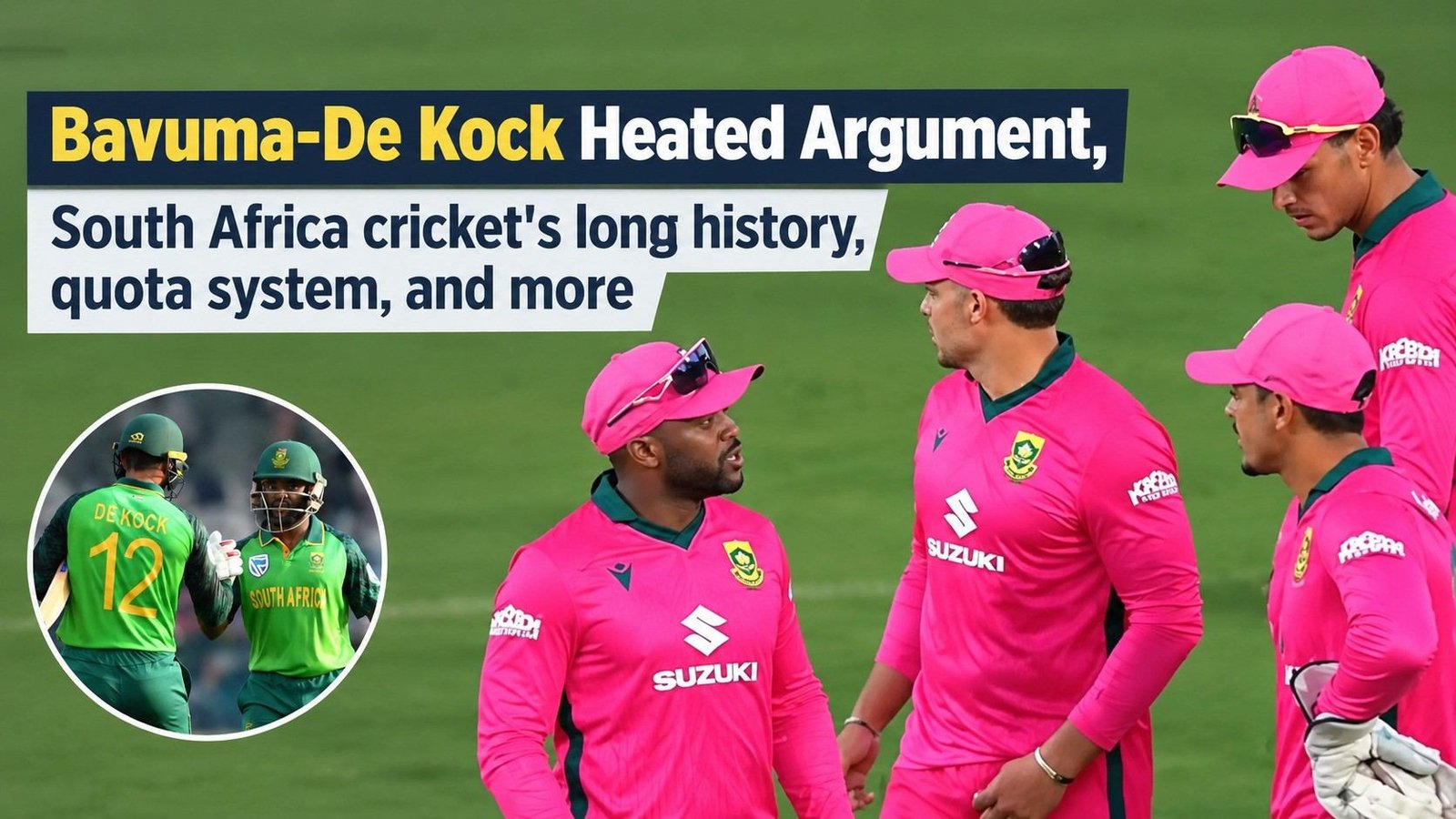
For a few seconds at the Wanderers, a routine cricket decision turned into a major talking point. South Africa were closing in on another win over Australia, but Xavier Bartlett was giving the visitors hope. Then Lizaad Williams struck Bartlett on the pads. The umpire said not out, leading to a tense discussion between Temba Bavuma and Quinton de Kock. Marco Jansen stepped in as the exchange became heated.
South Africa took the review, and Bartlett was given out. Soon, the moment spread online, raising questions about their history and South African cricket’s bigger issues.
What happened between Temba Bavuma and Quinton de Kock?
The exchange between Temba Bavuma and de Kock. He has to respect Bavuma as a captain. pic.twitter.com/zo8KBKNiNA
— Ngqanga Nentsiba Zayo (@Intengu_drongo) September 27, 2026
The incident happened during the fourth ball of the 48th over of Australia’s chase. South Africa had posted 365/9, with Temba Bavuma and David Miller scoring centuries.
However, Australia were still in the game, with Xavier Bartlett keeping their hopes alive after a record-equalling 26-ball fifty. Williams then bowled a yorker, and Bartlett missed his shot. The ball struck his back leg, prompting an immediate LBW appeal from South Africa.
The umpire, however, said not out. De Kock, standing behind the stumps, seemed unsure about the review, while Bavuma wanted to take it. As the DRS timer ran down, the two players had a heated exchange, with television footage showing pointing and strong gestures.
“Temba, have a look” Quinton de Kock said.
‘Don’t shout, man. F**** relax. I am asking him, ‘ Temba Bavuma replied.
Marco Jansen stepped in and appeared to calm the situation, with de Kock walking away. Bavuma then took the review. Ball-tracking showed the ball would hit the stumps, while UltraEdge confirmed no bat was involved.
The decision was overturned, and Bartlett was given out LBW. Bavuma got the call right, but their argument became the bigger story.
The moment became bigger than the DRS review
It is easy to understand why the players felt the pressure. Bartlett was playing an innings that could have changed the game. He finished with 50 from just 28 balls, matching Travis Head’s record for the fastest ODI fifty by an Australian against South Africa.
After Bartlett’s dismissal, Australia needed 44 runs from 14 balls. Nathan Ellis and Josh Hazlewood could add only 11 more runs before Williams dismissed Hazlewood with the second-last delivery.
Australia were bowled out for 333 and lost by 32 runs. South Africa sealed a 2-0 series lead, but the Bavuma-de Kock argument remained a major talking point. You can check the full scoreboard of this match HERE.
ALSO READ: Virat Kohli Has Confirmed His 2027 World Cup Plan, But What Happens After That?
Temba Bavuma and Quinton de Kock have a long history
Temba Bavuma and Quinton de Kock have been teammates for many years. Their cricketing relationship started when they played together as youngsters in Johannesburg. They later played for the Lions as well.
De Kock reached international cricket before Bavuma and also captained South Africa before him. When Bavuma became the white-ball captain in 2021, de Kock was already one of the team’s senior players. Bavuma has also spoken about taking tactical advice from him.
When de Kock retired from ODI cricket in 2023, Bavuma called him an “incredible player” and said his absence would be difficult because of his tactical input.
After the latest DRS incident, some social media users said the argument showed that de Kock did not fully accept Bavuma’s authority. However, the incident does not prove that.
Proteas coach Shukri Conrad also rejected the idea of a bigger team problem.
“Whenever Quinny gets involved, I laugh,” Conrad said, adding that viral social-media moments meant little to him or the change-room. He also called Bavuma and de Kock “best mates.”
Two senior players can argue without having a deeper issue.
The Quinton de Kock controversy that changed the conversation
The biggest chapter in their history came during the 2021 T20 World Cup.
Before South Africa’s match against West Indies in Dubai, Cricket South Africa asked its players to take the knee as a team gesture against racism.
De Kock decided not to take the knee and then made himself unavailable for the match.
His absence was initially explained as being for “personal reasons.” It later became clear that his decision was connected to CSA’s instruction about the anti-racism gesture.
The incident led to a major reaction, especially because of South Africa’s history of apartheid and racial inequality.
Temba Bavuma was the South African captain at the time. He said he was “surprised and taken aback” by the situation. However, he did not turn the issue into a personal attack on de Kock.
He said:
“Quinton is an adult. He’s a man in his own shoes. We respect his decision. We respect his convictions.”
Bavuma also said the situation was difficult for the team because de Kock was an important senior player.
De Kock later explained that he did not mean to disrespect anyone. He also said he understood why standing against racism was important.
He returned to the South African team and took the knee before the match against Sri Lanka.
De Kock also praised Bavuma’s leadership, calling him a “flipping amazing leader.”
This history matters when looking at their latest argument.
The two players have already faced a serious disagreement before, but they eventually moved past it.
Why Bavuma’s name is linked with transformation
Bavuma’s career has another important part that cannot be ignored.
He became the first black African batter to score a Test century for South Africa. He made 102 not out against England in 2016. Five years later, he became South Africa’s first permanent black African captain.
However, his selection has also faced debate because of South Africa’s transformation policies.
Apartheid had a major impact on South African cricket. During that period, race affected access to schools, facilities and top-level sport.
After apartheid ended, Cricket South Africa introduced transformation policies to improve access and representation.
These policies have led to a long debate.
At one stage, CSA’s national-team targets required an average of six players of colour, including at least two black African players, over a 12-month period. The team did not have to use the exact same combination in every match.
The main aim was to address the effects of years of racial exclusion.
However, the policy also created arguments about selection. Critics questioned whether demographic targets should play a role in choosing players. Supporters argued that deliberate action was needed to deal with the effects of historical inequality.
The debate became especially sensitive when Bavuma’s selection came under discussion because some people questioned his numbers.
ESPN noted that some critics called him a “quota player” when he first entered the team. Bavuma then had to deal with that criticism while building his international career.
Faf du Plessis also joined the debate in 2020 after South Africa failed to meet its transformation target against England.
Du Plessis said, “We don’t see colour,” while arguing that players should be selected on ability.
At the time, CSA’s policy required an average of six non-white players, including two black Africans, over 12 months.
His comment became controversial because South Africa’s history makes race and opportunity important parts of the selection debate.
This issue is bigger than Bavuma
The transformation debate has involved more than one captain. It has affected players, officials and fans across different generations. Some white South African players have also spoken about selection chances and transformation rules.
Former South African international Roelof van der Merwe, for example, discussed politics when he explained his decision to move abroad and later play for the Netherlands.
In 2016, Cricket South Africa CEO Haroon Lorgat rejected the idea that transformation targets gave players a valid reason to leave. He called it a “soft excuse” and said players should fight for places in representative teams.
This showed how divided South African cricket became over transformation.
The Kolpak era made things even more difficult
South African cricket also faced a major player drain over the years.
For many players, the Kolpak ruling created another career option. It allowed eligible South African cricketers to play county cricket in England without being treated as overseas players.
However, players who signed Kolpak deals generally became unavailable for international cricket while their contracts were active. As a result, many South Africans moved to England.
A 2023 academic study found that 37 of 116 South Africans who played international cricket during the period studied later signed Kolpak contracts in England. That was about 31.9%.
Kyle Abbott, Rilee Rossouw, Simon Harmer, Stiaan van Zyl and Hardus Viljoen were among the players linked to this trend.
Money was an important reason for some players. Transformation concerns also became part of the wider discussion about why players left.
The Kolpak system ended after Brexit, with registrations ending after the 2020 season. However, South African cricket still faced a similar challenge.
Players can now build careers in a global cricket market. England and franchise T20 leagues offer different financial and career opportunities.
Bavuma also spoke about the growing financial pull of franchise cricket. In 2023, he said it was becoming harder for players to ignore the money offered by T20 leagues.
This left South African cricket with two key questions: how to create more opportunities for historically excluded communities and how to keep talented players in the system.
ALSO READ: Hardik Pandya Injury Timeline: His monopoly, test cricket, all injuries in his career, and more
Did transformation makeTemba Bavuma captain?
This is where the social media debate needs to be separated from the available facts.
Some fans have linked Bavuma’s role as a black captain to South Africa’s transformation policies. Others have suggested that de Kock’s reaction showed that he did not fully accept Bavuma’s authority because of what he represents.
However, the Wanderers incident does not prove that motive. The footage shows a disagreement over a DRS decision. Bavuma took the review, and the review was successful. South Africa also won the match.
Coach Shukri Conrad has publicly called Bavuma and de Kock “best mates.” The wider transformation debate matters, but it should not automatically explain this argument.
Bavuma’s cricket has also changed the conversation
There is another important part of the story.
Temba Bavuma has built a long international career. He became South Africa’s first black African Test centurion and has led the team across formats. He remains an important batter in Test and ODI cricket.
Against Australia, he scored 103 from 116 balls. David Miller then made 142 from 93 balls as South Africa reached 365/9. Australia scored 333 in reply, but South Africa won by 32 runs.
Transformation policy is part of Bavuma’s story, but it does not define his entire career. South Africa’s history also cannot be ignored.
ALSO READ: Virat Kohli Just Did Something Even Sachin Tendulkar Couldn’t Do This Fast
And what about de Kock?
De Kock also has a complicated history with South African cricket.
He has been one of the country’s most attacking white-ball batters. He has also captained South Africa and remains an experienced player.
However, some of his decisions have created controversy. His 2021 decision over taking the knee remains the clearest example.
His later comments about Bavuma are also important. After returning to the team, de Kock thanked his captain and praised his leadership.
Because of this history, one heated DRS argument does not prove that de Kock disrespects Bavuma. Fans may view the footage differently. Some felt de Kock went too far, while others saw two experienced players arguing under pressure. Bavuma also made the correct call.
What happens next?
The DRS argument is unlikely to change the series result. South Africa have already taken an unassailable 2-0 lead.
Bavuma scored a century, Miller made 142, Bartlett hit one of Australia’s fastest ODI fifties against South Africa, and Williams finished the job for the hosts.
However, the viral exchange has reopened a much older conversation about South African cricket. It includes race, transformation, merit, leadership, player migration and the relationship between senior players.
For now, the available evidence points to a heated disagreement between two players who have known each other for years. It does not prove a deeper personal or racial conflict.
Will this remain just another argument between teammates, or become another chapter in South African cricket’s bigger story?
What do you think? Let us know in the comments.
Keep following Sportschilly for the latest updates.






One thought on “Temba Bavuma vs Quinton de Kock: What Really Happened During That Heated DRS Clash—and Why It Has Reopened an Old South Africa Debate”