


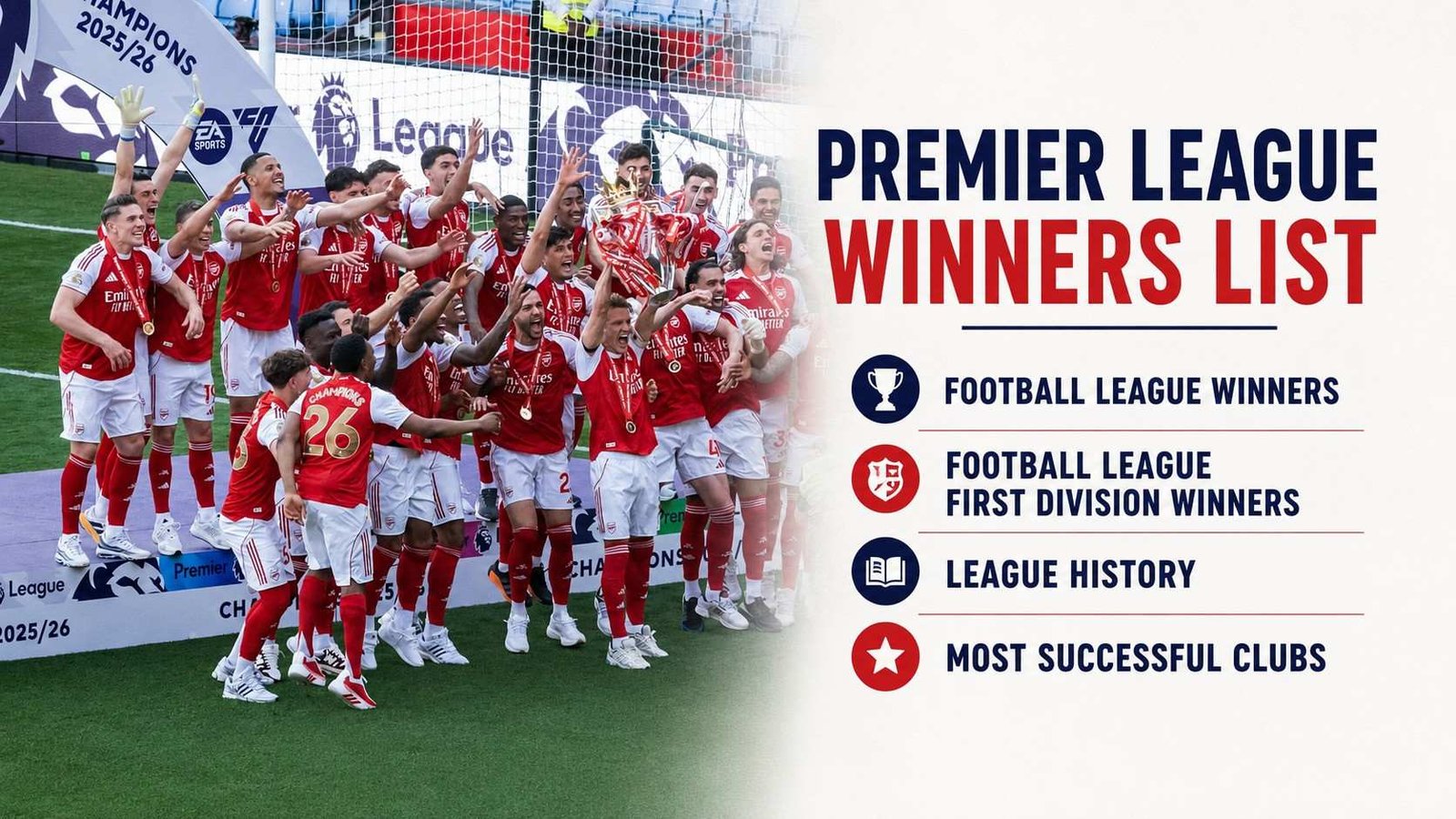
The Premier League Winners List is not only a list of modern trophies. It also shows how English football’s top league grew over time. It started with 12 clubs in 1888 and later became one of the most watched leagues in the world.
The Football League started in 1888 after meetings led by Aston Villa director William McGregor. Preston North End became the first champions in 1888–89. They finished the season without losing a game. At first, most clubs came from northern and central parts of England, where professional football was growing quickly.
Football League, 1888–1892
From 1888 to 1892, the competition was called the Football League. Preston North End were the first champions. Sunderland won the final title of this first four-season period in 1891–92.
This makes Preston North End the first club in the long history of the Premier League Winners List, even though the modern Premier League did not exist then. Preston also won the first two championships.
In 1892, the league became bigger by joining with the Football Alliance. It then had 28 clubs and was split into two divisions. The original league became the First Division. Promotion and relegation were also introduced between the two divisions.
| Season | Champions | Runners Up | Third Place |
| 1888–89 | Preston North End | Aston Villa | Wolverhampton Wanderers |
| 1889–90 | Preston North End | Everton | Blackburn Rovers |
| 1890–91 | Everton | Preston North End | Notts County |
| 1891–92 | Sunderland | Preston North End | Bolton Wanderers |
Football League First Division, 1892–1992
The Football League First Division was the top level for the next 100 years, from 1892–93 to 1991–92. Sunderland were the first champions under the First Division name, while Leeds United were the last, winning the title in 1991–92. This period had several important eras: Aston Villa were strong around the start of the twentieth century, Huddersfield Town won three titles in a row in the 1920s, and Liverpool became the leading team of the late twentieth century.
Liverpool’s First Division success was remarkable. The club won back-to-back titles in 1975–76 and 1976–77, then won three in a row from 1981–82 to 1983–84. These runs show how hard it was to stay dominant for a long time, even before the Premier League era.
The World Wars stopped the competition. The league was suspended from 1915–16 to 1918–19 during the First World War and from 1939–40 to 1945–46 during the Second World War.
Football League First Division Champions Table (1892–1992)
| Season | Champions | Runners Up | Third Place |
| 1892–93 | Sunderland | Preston North End | Everton |
| 1893–94 | Aston Villa | Sunderland | Derby County |
| 1894–95 | Sunderland | Everton | Aston Villa |
| 1895–96 | Aston Villa | Derby County | Everton |
| 1896–97 | Aston Villa | Sheffield United | Derby County |
| 1897–98 | Sheffield United | Sunderland | Wolverhampton Wanderers |
| 1898–99 | Aston Villa | Liverpool | Burnley |
| 1899–1900 | Aston Villa | Sheffield United | Sunderland |
| 1900–01 | Liverpool | Sunderland | Notts County |
| 1901–02 | Sunderland | Everton | Newcastle United |
| 1902–03 | The Wednesday | Aston Villa | Sunderland |
| 1903–04 | The Wednesday | Manchester City | Everton |
| 1904–05 | Newcastle United | Everton | Manchester City |
| 1905–06 | Liverpool | Preston North End | The Wednesday |
| 1906–07 | Newcastle United | Bristol City | Everton |
| 1907–08 | Manchester United | Aston Villa | Manchester City |
| 1908–09 | Newcastle United | Everton | Sunderland |
| 1909–10 | Aston Villa | Liverpool | Blackburn Rovers |
| 1910–11 | Manchester United | Aston Villa | Sunderland |
| 1911–12 | Blackburn Rovers | Everton | Newcastle United |
| 1912–13 | Sunderland | Aston Villa | The Wednesday |
| 1913–14 | Blackburn Rovers | Aston Villa | Middlesbrough |
| 1914–15 | Everton | Oldham Athletic | Blackburn Rovers |
| 1915–16 to 1918–19 | League suspended due to the First World War | — | — |
| 1919–20 | West Bromwich Albion | Burnley | Chelsea |
| 1920–21 | Burnley | Manchester City | Bolton Wanderers |
| 1921–22 | Liverpool | Tottenham Hotspur | Burnley |
| 1922–23 | Liverpool | Sunderland | Huddersfield Town |
| 1923–24 | Huddersfield Town | Cardiff City | Sunderland |
| 1924–25 | Huddersfield Town | West Bromwich Albion | Bolton Wanderers |
| 1925–26 | Huddersfield Town | Arsenal | Sunderland |
| 1926–27 | Newcastle United | Huddersfield Town | Sunderland |
| 1927–28 | Everton | Huddersfield Town | Leicester City |
| 1928–29 | The Wednesday | Leicester City | Aston Villa |
| 1929–30 | Sheffield Wednesday | Derby County | Manchester City |
| 1930–31 | Arsenal | Aston Villa | Sheffield Wednesday |
| 1931–32 | Everton | Arsenal | Sheffield Wednesday |
| 1932–33 | Arsenal | Aston Villa | Sheffield Wednesday |
| 1933–34 | Arsenal | Huddersfield Town | Tottenham Hotspur |
| 1934–35 | Arsenal | Sunderland | Sheffield Wednesday |
| 1935–36 | Sunderland | Derby County | Huddersfield Town |
| 1936–37 | Manchester City | Charlton Athletic | Arsenal |
| 1937–38 | Arsenal | Wolverhampton Wanderers | Preston North End |
| 1938–39 | Everton | Wolverhampton Wanderers | Charlton Athletic |
| 1939–40 to 1945–46 | League suspended due to the Second World War | — | — |
| 1946–47 | Liverpool | Manchester United | Wolverhampton Wanderers |
| 1947–48 | Arsenal | Manchester United | Burnley |
| 1948–49 | Portsmouth | Manchester United | Derby County |
| 1949–50 | Portsmouth | Wolverhampton Wanderers | Sunderland |
| 1950–51 | Tottenham Hotspur | Manchester United | Blackpool |
| 1951–52 | Manchester United | Tottenham Hotspur | Arsenal |
| 1952–53 | Arsenal | Preston North End | Wolverhampton Wanderers |
| 1953–54 | Wolverhampton Wanderers | West Bromwich Albion | Huddersfield Town |
| 1954–55 | Chelsea | Wolverhampton Wanderers | Portsmouth |
| 1955–56 | Manchester United | Blackpool | Wolverhampton Wanderers |
| 1956–57 | Manchester United | Tottenham Hotspur | Preston North End |
| 1957–58 | Wolverhampton Wanderers | Preston North End | Tottenham Hotspur |
| 1958–59 | Wolverhampton Wanderers | Manchester United | Arsenal |
| 1959–60 | Burnley | Wolverhampton Wanderers | Tottenham Hotspur |
| 1960–61 | Tottenham Hotspur | Sheffield Wednesday | Wolverhampton Wanderers |
| 1961–62 | Ipswich Town | Burnley | Tottenham Hotspur |
| 1962–63 | Everton | Tottenham Hotspur | Burnley |
| 1963–64 | Liverpool | Manchester United | Everton |
| 1964–65 | Manchester United | Leeds United | Chelsea |
| 1965–66 | Liverpool | Leeds United | Burnley |
| 1966–67 | Manchester United | Nottingham Forest | Tottenham Hotspur |
| 1967–68 | Manchester City | Manchester United | Liverpool |
| 1968–69 | Leeds United | Liverpool | Everton |
| 1969–70 | Everton | Leeds United | Chelsea |
| 1970–71 | Arsenal | Leeds United | Tottenham Hotspur |
| 1971–72 | Derby County | Leeds United | Liverpool |
| 1972–73 | Liverpool | Arsenal | Leeds United |
| 1973–74 | Leeds United | Liverpool | Derby County |
| 1974–75 | Derby County | Liverpool | Ipswich Town |
| 1975–76 | Liverpool | Queens Park Rangers | Manchester United |
| 1976–77 | Liverpool | Manchester City | Ipswich Town |
| 1977–78 | Nottingham Forest | Liverpool | Everton |
| 1978–79 | Liverpool | Nottingham Forest | West Bromwich Albion |
| 1979–80 | Liverpool | Manchester United | Ipswich Town |
| 1980–81 | Aston Villa | Ipswich Town | Arsenal |
| 1981–82 | Liverpool | Ipswich Town | Manchester United |
| 1982–83 | Liverpool | Watford | Manchester United |
| 1983–84 | Liverpool | Southampton | Nottingham Forest |
| 1984–85 | Everton | Liverpool | Tottenham Hotspur |
| 1985–86 | Liverpool | Everton | West Ham United |
| 1986–87 | Everton | Liverpool | Tottenham Hotspur |
| 1987–88 | Liverpool | Manchester United | Nottingham Forest |
| 1988–89 | Arsenal | Liverpool | Nottingham Forest |
| 1989–90 | Liverpool | Aston Villa | Tottenham Hotspur |
| 1990–91 | Arsenal | Liverpool | Crystal Palace |
| 1991–92 | Leeds United | Manchester United | Sheffield Wednesday |
Premier League, 1992–present
The modern Premier League started in 1992 when First Division clubs left the Football League to create the FA Premier League as a new top division. Larger TV deals changed the money in football and helped English football become popular around the world.
Manchester United were the first Premier League champions in 1992–93. Arsenal are the current champions after winning the 2025–26 season, their 14th English top-flight title according to the supplied record. The Premier League Winners List shows how the strongest teams changed over time: Manchester United dominated the early years, Chelsea and Arsenal stopped that run, Manchester City became a major modern force, and Liverpool returned to the top in 2019–20 and 2024–25.
Here is the Premier League Winners List by year; the season-by-season table below is the easiest reference.
ALSO READ: UEFA Nations League Winners (Each Season)
Premier League Champions Table (1992–present)
| Season | Champions | Runners Up | Third Place |
| 1992–93 | Manchester United | Aston Villa | Norwich City |
| 1993–94 | Manchester United | Blackburn Rovers | Newcastle United |
| 1994–95 | Blackburn Rovers | Manchester United | Nottingham Forest |
| 1995–96 | Manchester United | Newcastle United | Liverpool |
| 1996–97 | Manchester United | Newcastle United | Arsenal |
| 1997–98 | Arsenal | Manchester United | Liverpool |
| 1998–99 | Manchester United | Arsenal | Chelsea |
| 1999–2000 | Manchester United | Arsenal | Leeds United |
| 2000–01 | Manchester United | Arsenal | Liverpool |
| 2001–02 | Arsenal | Liverpool | Manchester United |
| 2002–03 | Manchester United | Arsenal | Newcastle United |
| 2003–04 | Arsenal | Chelsea | Manchester United |
| 2004–05 | Chelsea | Arsenal | Manchester United |
| 2005–06 | Chelsea | Manchester United | Liverpool |
| 2006–07 | Manchester United | Chelsea | Liverpool |
| 2007–08 | Manchester United | Chelsea | Arsenal |
| 2008–09 | Manchester United | Liverpool | Chelsea |
| 2009–10 | Chelsea | Manchester United | Arsenal |
| 2010–11 | Manchester United | Chelsea | Manchester City |
| 2011–12 | Manchester City | Manchester United | Arsenal |
| 2012–13 | Manchester United | Manchester City | Chelsea |
| 2013–14 | Manchester City | Liverpool | Chelsea |
| 2014–15 | Chelsea | Manchester City | Arsenal |
| 2015–16 | Leicester City | Arsenal | Tottenham Hotspur |
| 2016–17 | Chelsea | Tottenham Hotspur | Manchester City |
| 2017–18 | Manchester City | Manchester United | Tottenham Hotspur |
| 2018–19 | Manchester City | Liverpool | Chelsea |
| 2019–20 | Liverpool | Manchester City | Manchester United |
| 2020–21 | Manchester City | Manchester United | Liverpool |
| 2021–22 | Manchester City | Liverpool | Chelsea |
| 2022–23 | Manchester City | Arsenal | Manchester United |
| 2023–24 | Manchester City | Arsenal | Liverpool |
| 2024–25 | Liverpool | Arsenal | Manchester City |
| 2025–26 | Arsenal | Manchester City | Manchester United |
You can check all the fixtures of the Premier League 2026 HERE
Most successful clubs
Liverpool and Manchester United lead the all-time table with 20 English top-flight titles each. Arsenal have 14, Manchester City have 10, and Everton have nine. Aston Villa have seven, while Sunderland and Chelsea have six each.
The modern era added an important chapter. Manchester City won four Premier League titles in a row from 2020–21 to 2023–24, a run not matched in the supplied Premier League record. Manchester United also had long periods of success, including three titles in a row from 1998–99 to 2000–01 and another three-title run from 2006–07 to 2008–09. Arsenal’s 2003–04 season was special for another reason: the club finished unbeaten, becoming a memorable champion in English football history.
Leicester City’s 2015–16 title is another major moment. Their win remains one of the biggest surprises in the competition. Nottingham Forest’s 1977–78 success and Derby County’s 1971–72 title were earlier examples of clubs breaking into the champions’ group.
ALSO READ: Japan and South Korea Football: How East Asia Became Asia’s Footballing Powerhouse?
List of champion clubs by titles won
| Rank | Club | Winners | Runners-up |
| 1 | Liverpool | 20 | 15 |
| 1 | Manchester United | 20 | 17 |
| 3 | Arsenal | 14 | 12 |
| 4 | Manchester City | 10 | 7 |
| 5 | Everton | 9 | 7 |
| 6 | Aston Villa | 7 | 10 |
| 7 | Sunderland | 6 | 5 |
| 7 | Chelsea | 6 | 4 |
| 9 | Sheffield Wednesday | 4 | 1 |
| 9 | Newcastle United | 4 | 2 |
| 11 | Blackburn Rovers | 3 | 1 |
| 11 | Huddersfield Town | 3 | 3 |
| 11 | Wolverhampton Wanderers | 3 | 5 |
| 11 | Leeds United | 3 | 5 |
| 15 | Preston North End | 2 | 6 |
| 15 | Burnley | 2 | 2 |
| 15 | Portsmouth | 2 | 0 |
| 15 | Tottenham Hotspur | 2 | 5 |
| 15 | Derby County | 2 | 3 |
| 20 | Sheffield United | 1 | 2 |
| 20 | West Bromwich Albion | 1 | 2 |
| 20 | Ipswich Town | 1 | 2 |
| 20 | Nottingham Forest | 1 | 2 |
| 20 | Leicester City | 1 | 1 |
The Premier League Winners List shows how English football has changed over more than a century. From Preston North End to modern champions, each era has added new clubs, records, rivalries, and memorable moments.
Which Premier League club do you think has made the biggest impact on English football, and why? Let us know your thoughts in the comments.
Keep following SportsChilly for the latest updates.