












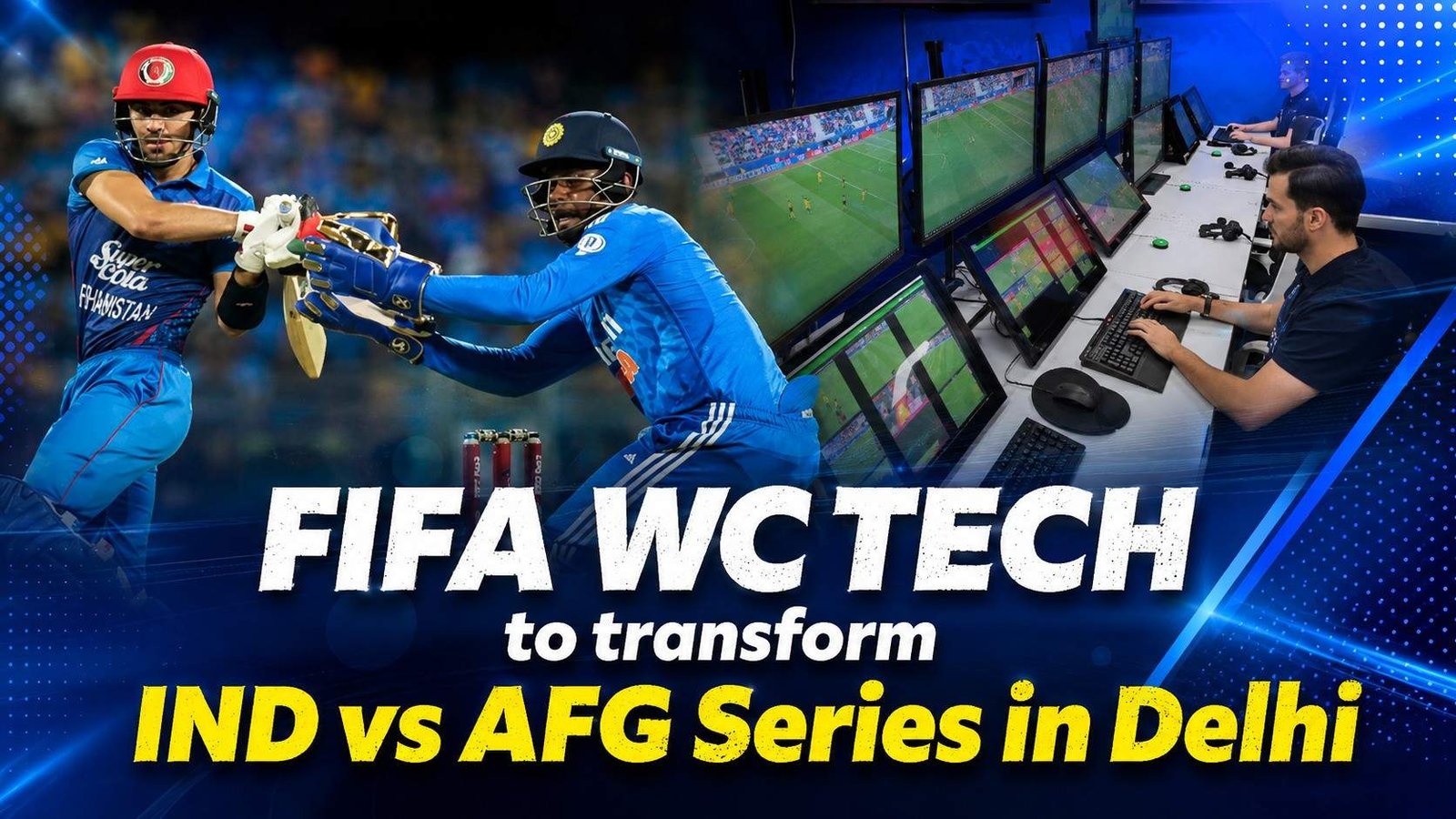
The upcoming India vs Afghanistan T20I series in New Delhi will give viewers a very different broadcast experience. The team will bring production technology, experts and knowledge from the FIFA World Cup 2026 into cricket. The three-match series will take place on September 13, 15 and 17. ITW Universe, the rights holder, will produce the matches using full FIFA World Cup host-broadcast standards.
The India vs Afghanistan series will be telecast live on Sony Sports and streamed on FanCode. The broadcaster will use new production methods instead of only using traditional cricket technology. These will include AI-stabilised POV cameras, volumetric free-viewpoint technology, advanced Spidercam, ultra-motion cameras and cine-style storytelling.
The production team will also have experts who have worked at major football events. Jamie Oakford has directed every FIFA World Cup since 2002. He has also worked on many UEFA Champions League Finals, including the 2014 FIFA World Cup Final. He will lead the gallery for the series.
ITW Universe founder Bhairav Shanth explained the idea behind the new production. He said the team wants to change how viewers watch live cricket and bring them closer to the action.
“We endorse his philosophy, which is to give the viewer the best seat in the house,” said Shanth.
This approach could give cricket fans a closer, clearer and more immersive view of every important moment during the series.
From football’s biggest stage to Delhi’s cricket field: India vs Afghanistan
The biggest talking point about the broadcast is the use of FIFA World Cup 2026 technology for a bilateral cricket series. ITW Universe says this will be the first bilateral cricket series to use full FIFA World Cup host-broadcast standards.
The company wants to take cricket coverage beyond the production methods used for more than a decade. Shanth said the goal is not just to use more cameras. The team also wants to find new ways to tell the story of a match.
The ITW Universe founder said the upcoming series will try to change the usual production methods. He also said it will give viewers and commercial partners a different experience.
“We want to move away from the same old production technology that has been used in cricket for the last 10-12 years,” says Shanth. “The series will give new experiences to the viewers and brands.”
One of the most unique additions will be Quidich Innovation Labs’ Spatio system. It combines a stabilised drone feed with broadcast-grade augmented reality and real-time optical player tracking. This will help the production team show field positions, explain strategies and use new angles to show what is happening on the pitch.
ALSO READ: Rishabh Pant Just Did Something No Indian Had Done Before
Technology that can change cricket storytelling
Another major addition will be a special ultra-slow-motion camera system, known as Emperor-style or Phantom class. It can record footage at 600 frames per second and above. This will help capture deliveries, bat contact, edges, stumpings and fielding moments in great detail.
For viewers, this will offer more than just impressive replays. The extra frames will help broadcasters explain important moments. They can also use small details from a delivery or dismissal to make the match story more interesting.
The series will also use volumetric Free Viewpoint technology. A group of cameras will create a real-time 3D digital twin of the pitch and players. This will allow broadcasters to place a virtual camera at different points around the action.
This means replays can show views that a normal physical camera cannot capture. Instead of watching the same replay from another fixed angle, viewers can get a better view of player movement, positions and key moments.
The production will combine these systems with Spidercam, AI-stabilised POV cameras and cine-style production. This could make the India vs Afghanistan series both a technology showcase and an important bilateral cricket contest.
India vs Afghanistan: The series and its wider context
The IND vs AFG T20 2026 series will take place at the Arun Jaitley Cricket Stadium in Delhi. All three matches will be played at the same venue. The first T20I will take place on September 13. The second will be on September 15, followed by the third on September 17.
| No. | Date | Day | Venue |
| 1 | 13-Sep-26 | Sunday | Delhi |
| 2 | 15-Sep-26 | Tuesday | Delhi |
| 3 | 17-Sep-26 | Thursday | Delhi |
The IND vs AFG 2026 T20I Schedule gives Delhi fans three chances to watch the two teams play. Afghanistan has also used India as a venue for its home matches in recent years.
The series is part of Afghanistan’s Future Tours Program. It also follows the teams’ recent matches in different formats. Afghanistan last toured India for a three-match ODI series in June 2026. The two teams also played a three-match T20I series in January 2024. India hosted Afghanistan for their first-ever Test in 2018.
BCCI President Mithun Manhas spoke about the importance of regular bilateral cricket for Afghanistan’s growth and the strong relationship between the two boards. He also said the BCCI would continue to support Afghanistan cricket and improve cooperation between the two countries.
For Afghanistan, the series is important beyond the matches. ACB Chairman Mirwais Ashraf said the event could bring opportunities in commercial, technical and cricketing areas. He also said it could make the relationship with the BCCI stronger.
The India vs Afghanistan T20 2026 series will, therefore, have two main stories. One will be the cricket contest on the field. The other will be the new way of showing that contest to viewers.
ALSO READ: India vs Pakistan Hockey: India Win 5-3 to Knock Pakistan Out
What this could mean for future cricket broadcasts
The biggest benefit of FIFA World Cup 2026 technology in cricket could be making important moments easier and more interesting to understand. Real-time tracking, augmented reality, volumetric replays and ultra-slow-motion footage can give broadcasters more ways to explain tactics, player positions and key moments.
For brands, these technologies could also create new ways to present stories and content. For viewers, the biggest change could be feeling closer to the action. New replays and camera angles can show viewers that traditional coverage cannot easily provide.
If the technology works well, the Afghanistan-India T20I series could become an example for future cricket broadcasts. It could be especially useful for broadcasters who want to combine normal live coverage with more immersive visuals.
As the India vs Afghanistan series gets closer, the main question will be whether these new technologies improve the viewing experience without taking attention away from the cricket itself.
What do you think? Could this technology-led production change how viewers expect bilateral cricket to be broadcast in the future? Let us know in the comments.
Keep following SportsChilly for the latest updates.