





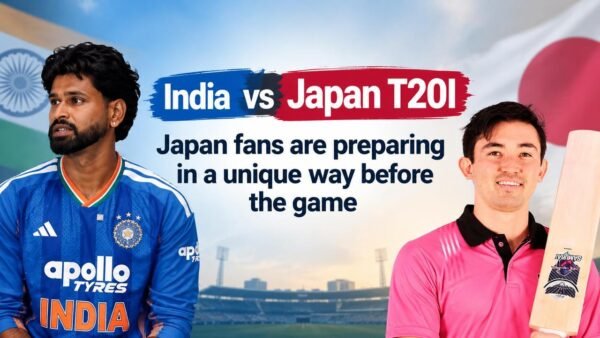







Cricket wants to become a truly global sport. More countries are playing international cricket, major tournaments are getting bigger, and traditional cricketing powers are increasingly sharing the field with emerging nations.
On paper, that looks like progress.
But the expansion also brings a difficult question. Can cricket grow into new countries without affecting the quality of the game along the way?
The recent match between India and Japan offered an interesting example. India entered the contest as the far more established cricketing nation, while Japan is still developing at the international level. Rain reduced the game to only five overs, while the surface also made stroke-making difficult.
Suddenly, the difference between the two teams did not look nearly as large on the scoreboard.
It raises a much bigger debate. Difficult pitches and shorter games can bring teams closer together, but do they always produce the standard expected from international cricket? At the same time, if emerging countries are not given these matches and opportunities, how are they ever supposed to improve?
There is no simple answer.
Why shortening the format can bring two very different teams much closer
The shorter a cricket match becomes, the less time the stronger team has to show its overall quality.
In a 50-over game, each side can potentially face 300 balls. In a normal T20, there are 120 balls per innings. Reduce that to five overs and a batting team gets only 30 deliveries.
That completely changes the importance of individual moments.
One excellent over, two quick wickets, a dropped catch or even a few dot balls can suddenly have a huge influence on the result. A stronger team does not have another 15 overs to recover from a poor start.
Now add a difficult batting surface.
On a good batting wicket, the ball comes nicely onto the bat. Better power-hitters can find boundaries, batting depth becomes more important, and the stronger side gets more opportunities to use its quality.
A slow or gripping surface changes that equation. The ball can arrive slower than expected, timing becomes difficult and spinners and slower deliveries become more effective.
This does not automatically make it a bad pitch. A low-scoring wicket can still be a good cricket surface if its bounce is consistent and its behaviour is reasonably predictable. But such conditions can reduce scoring and make the difference between two batting line-ups less obvious.
Combine those conditions with a five-over match, and the margin for error becomes extremely small.
That was part of what made the India-Japan contest so interesting. India had only 30 deliveries to establish its superiority. There was almost no time to understand the surface before attacking.
In that situation, the stronger team can still win, but its larger skill advantage may not appear on the scoreboard in the way it could over 20 or 50 overs.
The 2024 T20 World Cup showed something similar
This is not the first time difficult batting conditions have made international T20 matches unusually close.
The 2024 T20 World Cup provided several examples.
India were bowled out for only 119 against Pakistan in New York. In modern T20 cricket, where scores above 200 have become increasingly common, 119 would normally appear extremely vulnerable.
Pakistan still could not chase it. They finished on 113/7 as India won by six runs.
South Africa’s games offered more examples. Sri Lanka were dismissed for 77 against them in New York, yet South Africa needed 16.2 overs to complete the chase.
Against the Netherlands, South Africa were chasing only 104 but fell to 12/4 before eventually recovering.
They later made only 113/6 against Bangladesh and successfully defended the total by four runs.
The South Africa-Nepal game, played in St Vincent rather than New York, was another example of how low-scoring T20 cricket can reduce the visible difference between two teams. South Africa scored 115/7. Nepal reached 114/7 and lost by just one run.
A major cricketing nation had been pushed to the final moments by an Associate side.
That can be viewed in two completely different ways.
For one viewer, it is exactly what global cricket needs: unpredictability, pressure and an emerging nation challenging a major team.
For another, the question may be why an international T20 surface is producing a game in which a total close to 115 is enough to win.
Both perspectives are worth considering.
ALSO READ: Lionel Messi All FIFA World Cup Goals: The Story Behind Every Strike From 2006 to 2026
Low scoring does not automatically mean poor cricket
There is an important distinction here.
A pitch should not be called poor simply because batters cannot score 200.
Cricket is supposed to provide a contest between bat and ball. A surface offering spin, seam or some assistance to bowlers can create fascinating cricket.
The problem begins when the behaviour becomes excessively unpredictable or when the quality of the surface itself becomes an issue.
That distinction mattered during the 2024 World Cup in New York.
The Nassau County International Cricket Stadium was created specifically for the tournament, and drop-in pitches were used. After the opening matches, the ICC acknowledged that the surfaces had not played as consistently as expected and said the ground staff were working to improve them.
That was not evidence that the United States simply could not produce good cricket pitches. Other American venues had different conditions and infrastructure.
Instead, New York highlighted one of the practical problems that can come with taking elite cricket into a developing market: cricket infrastructure cannot always be created as quickly as cricket’s global ambitions.
A cricket pitch needs much more than a flat piece of ground
Countries such as India, England and Australia have had generations to develop their cricket infrastructure.
Their major grounds have experienced curators, established squares, specialist equipment, drainage systems and years of knowledge about how local soil and weather affect a wicket.
Emerging cricket countries may not have the same depth of experience.
Producing a good cricket pitch requires suitable soil, correct moisture levels, rolling, grass management, drainage and an understanding of local weather. The surface then needs regular use and testing.
Even a batting-friendly wicket is not simply a pitch with no grass.
For good T20 batting, players generally need reliable bounce and enough pace for the ball to come onto the bat. If the surface is too slow, soft or gripping, batters have to generate much more of the pace themselves.
Outfield quality matters too. A slow or wet outfield can turn potential boundaries into twos and threes.
That is why moving cricket into countries where the sport has a smaller footprint presents a challenge. The stadium may exist, but the wider cricket ecosystem can take much longer to develop.
ALSO READ: Gianni Infantino Makes Major FIFA Move After Weeks of Pressure—but What Could Change Now?
But Associate nation does not mean poor infrastructure
It would also be wrong to put every Associate nation into the same category.
The UAE has hosted IPL matches, international series, and major ICC tournaments. Oman has hosted major international cricket as well. The Netherlands has a long cricketing history and has repeatedly competed against Full Member teams.
These examples are important because they show that cricket popularity and pitch quality do not have a simple relationship.
A country does not need cricket to be its number one sport to produce good playing conditions.
Infrastructure, investment, expertise, climate, preparation and experience matter far more.
That is also why one problematic venue in the United States cannot be used to judge every cricket ground in the country, just as one slow surface in Japan cannot establish that Japan is incapable of producing international-standard wickets.
Then there is the other quality problem: one-sided matches
Playing conditions are only one part of the debate.
The standard of competition is another.
India, Australia, England and South Africa have professional systems, large player pools and decades of elite international experience.
Some emerging Associate teams are operating at a completely different stage of development.
Put the two together and the result can sometimes be a mismatch.
For viewers, that can create a genuine entertainment problem. International tournaments are expected to offer meaningful competition. If the result appears almost certain before the match starts, some fans may lose interest.
That creates an uncomfortable question for cricket administrators.
Should a global tournament focus primarily on bringing together the best teams currently available, or should it also be responsible for helping create the strong teams of the future?
Those goals do not always produce the same short-term result.
Associate teams cannot improve without playing better opposition
This is where restricting expansion creates its own problem.
Suppose Japan is considered too weak to play India.
If Japan therefore rarely gets to play teams of India’s standard, how does the gap close?
Domestic and regional competitions can develop players, but there is a limit to what a player can learn without experiencing elite international cricket.
Facing high-quality pace, world-class spin and international pressure teaches lessons that training cannot completely reproduce.
The same applies to tactics, fitness, fielding and handling difficult moments.
A team may initially lose heavily. After repeated exposure, however, players begin understanding what the next level requires.
Today’s mismatch can therefore be part of the process that prevents tomorrow’s mismatch.
Associate cricket has already provided evidence that the gap is not permanent. The United States defeated Pakistan in the 2024 T20 World Cup and reached the Super Eight. The Netherlands has produced major upsets over established cricket nations, while emerging teams have increasingly shown that they can trouble stronger opposition.
That progress does not happen without opportunities.
ALSO READ: Ajit Agarkar Exit Looms? 5 Names Who Could Take Over as India’s Next Chief Selector
T20 cricket is also the logical format for expansion
There is another reason Associate cricket is closely connected with T20.
It is much easier for a developing cricket nation to build a competitive T20 setup than immediately create the depth required for Test cricket.
T20 requires less playing time, is easier to schedule and can potentially attract new viewers who are unfamiliar with the sport.
But the format itself increases unpredictability.
The stronger team has only 120 balls to establish its advantage. If rain reduces that to ten, eight or five overs, the influence of a handful of moments becomes even greater.
A simple comparison explains it.
A superior long-distance runner has plenty of time to demonstrate endurance over a marathon. In a very short race, one poor start becomes much more significant.
Cricket works similarly.
Over 50 overs, quality has hundreds of deliveries to show itself. Over five overs, one exceptional over can represent 20 percent of the entire innings.
Then put that five-over game on a slow surface and the gap can compress further.
That does not necessarily mean the weaker team has suddenly become equally skilled. It means the conditions and format have reduced the amount of cricket available for the difference in quality to show itself.
But difficult conditions can also help the stronger team
There is another side to this argument.
It would be too simple to say that low-scoring pitches automatically benefit weaker teams.
The stronger team usually has better bowlers too.
India’s 119 against Pakistan in 2024 looked like a very small total. But Pakistan still had to chase those runs against an Indian attack led by Jasprit Bumrah.
Similarly, restricting a major team to 110 is only half the job for an Associate nation. It may then have to score 111 against an elite international attack on the same difficult surface.
Therefore, challenging conditions do not simply remove the skill gap.
Sometimes they change where that gap becomes visible.
Instead of superior batting producing 220, superior bowling may become the decisive factor in defending 120.
The bigger problem: how do new markets build infrastructure without major cricket?
This may be the most difficult part of the entire debate.
Suppose cricket administrators decide that a country should not host major matches until its infrastructure reaches the level of India, Australia or England.
Where does the money and motivation to build that infrastructure come from?
A World Cup or major international series can encourage governments, boards and private investors to spend money on grounds, academies and facilities.
It can introduce cricket to new audiences.
It can give local children visible players to follow.
It can attract sponsors.
It can also create demand for better coaches, curators and domestic competitions.
Without major cricket, many of those developments may happen much more slowly.
The sport therefore faces something of a chicken-and-egg problem.
It needs strong infrastructure to take elite cricket into new countries.
But those countries may need elite cricket to justify building strong infrastructure in the first place.
Promotion cannot become an excuse for poor standards
That does not mean every problem should be accepted in the name of development.
International cricket still needs minimum standards.
Players should not be expected to compete on surfaces that create unreasonable safety concerns. World tournaments should have suitable outfields, training facilities and properly prepared wickets.
Similarly, simply putting an emerging team into a World Cup every few years is not enough to build competitive cricket.
Development needs to happen between major tournaments as well.
Associate nations need regular international fixtures, stronger domestic competitions, regional tournaments, quality coaching and better facilities. Matches against A teams and stronger national sides can also provide a bridge between regional cricket and the pressure of a World Cup.
If those structures improve, a World Cup appearance becomes part of a development pathway rather than a rare opportunity followed by another long wait.
Expansion can lower the immediate standard and raise the future standard
This is perhaps the central contradiction facing cricket.
In the short term, expansion can produce uneven matches.
A developing team may struggle badly against Australia or India. A new host market may discover that preparing elite cricket facilities is more complicated than expected.
For viewers accustomed to the highest standard, those matches can sometimes feel below what they expect from a major international event.
But refusing to expand creates a different long-term risk.
The same small group of countries continues playing each other. New markets receive little exposure. Associate players rarely test themselves against elite opposition. Investment becomes harder to attract.
The immediate standard might remain higher, but the sport’s potential playing base remains smaller.
On the other hand, expansion accepts some short-term imperfections in the hope of creating stronger teams and better cricket infrastructure in the future.
Neither approach comes without a cost.
ALSO READ: Kapil Dev opens up on India-Pakistan rivalry, Imran Khan and the leadership lessons that shaped him
Cricket therefore has to expand without treating expansion itself as enough
The debate should perhaps not be reduced to whether cricket should enter countries such as the United States or Japan.
It should.
A sport cannot call itself global while avoiding countries simply because they do not already have a century of cricket history.
But taking international matches there should only be the beginning.
Infrastructure has to develop alongside expansion. Pitches need adequate preparation and testing. Local curators need access to expertise. Domestic cricket needs investment. Associate teams need regular high-quality opposition rather than occasional appearances against giants.
At the same time, traditional powers may have to accept that not every step in cricket’s global development will immediately look like the finished product.
Some games will be one-sided.
Others may become unusually close because rain, a shortened format or difficult conditions reduce the difference between teams.
Some emerging nations will struggle before improving.
And occasionally, they will produce an upset that shows exactly why they needed the opportunity in the first place.
That leaves cricket with a difficult balancing act.
Protect the existing standard too aggressively and the sport risks remaining concentrated in a relatively small number of countries.
Expand too quickly without matching that ambition with infrastructure and development, and international cricket can face questions about pitches, facilities and competitive quality.
Perhaps, then, the most useful question is not whether cricket’s global expansion is good or bad.
Cricket’s global growth creates new opportunities, but the real challenge is whether infrastructure, player development and competitive standards can improve quickly enough to match its ambitions.
Can cricket reach new markets without compromising the standards that make international competition exciting? What do you think? Let us know in the comments.
Keep following Sportschilly for the latest updates.