





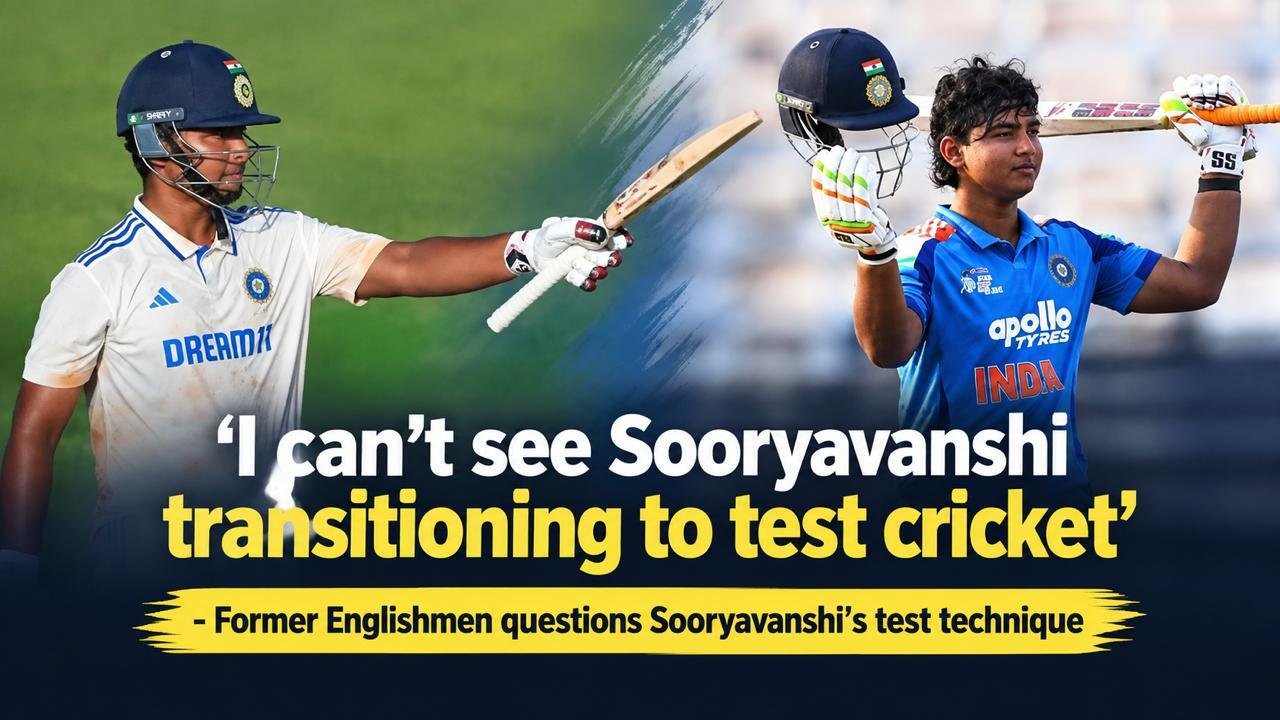
Vaibhav Sooryavanshi has already achieved things that many batters take years to achieve. At just 15, he has made a big impact in the IPL, played for India, and produced remarkable numbers in T20 cricket.
But one big question is now coming up more often: can the teenager take the same attacking style into Test cricket?
Former England spinner Monty Panesar has shared a clear view after watching Sooryavanshi. His comments have also started a bigger discussion about the youngster’s batting technique, his first-class record and whether his aggressive T20 style can work in red-ball cricket.
At the same time, former Australia captain Michael Clarke has a more positive view of Sooryavanshi’s Test potential.
What did Monty Panesar say about Vaibhav Sooryavanshi?
Panesar spoke about Vaibhav Sooryavanshi’s Test potential while appearing with Clarke on the Beyond23 Cricket Podcast. They discussed whether modern players can succeed in all three formats and whether Sooryavanshi’s current batting style can handle the demands of Test cricket.
Panesar mainly questioned whether the teenager has the technical base needed for the longest format.
Before giving his opinion, Panesar said he could not currently see Sooryavanshi making the move to Test cricket. He also mentioned Harry Brook while talking about players who have already shown that they can perform in different formats.
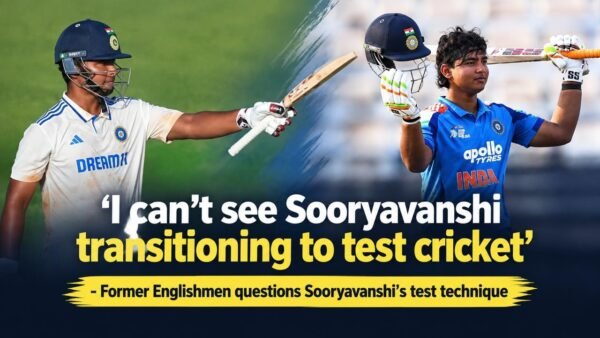
“I can’t see Sooryavanshi transitioning to Test cricket. Harry Brook is the only one right now who’s in the top 10 in Tests and T20Is. But I just don’t think Sooryavanshi has got the technique,” Panesar said on the Beyond23 Cricket Podcast.
The key word in Panesar’s comments is “technique.” He was not questioning Sooryavanshi’s ability to hit sixes or score quickly in T20 cricket. His main concern was whether the same batting method can work in Test cricket.
Test cricket brings different challenges. Batters can face long spells from fast bowlers, movement from the pitch, changing conditions and attacking fields. They also have to know when to attack and when to defend or leave the ball.
This is why Sooryavanshi’s red-ball record becomes important.
Sooryavanshi’s T20 numbers are huge, but his first-class record is different
There is little doubt about Vaibhav Sooryavanshi’s success in T20 cricket. He finished IPL 2026 as the Orange Cap winner after scoring 776 runs in 16 innings at a strike rate of 237.31. He also hit 72 sixes in the tournament.
His overall T20 record is also impressive. He has scored 1,670 runs in 40 T20 matches, averaging 42.82 at a strike rate of 216.32. He has also scored four centuries and eight fifties.
His start in international cricket has been equally aggressive. After six T20I innings, Sooryavanshi has scored 193 runs at a strike rate of 189.21, including two half-centuries. Against Zimbabwe, he scored 151 runs in three matches at a strike rate of 196.10.
However, his first-class record is much more modest. Before the latest red-ball matches, his available first-class numbers showed 399 runs in 17 innings at an average of 23.47. His highest score was 93.
This difference explains why Panesar’s comments have created so much discussion.
These numbers do not prove that Sooryavanshi cannot become a successful Test batter. He is only 15 and has played very little senior red-ball cricket. However, they explain why people are asking questions about his ability to make the transition.
ALSO READ: India vs Japan T20I Preview: More Than Just a Cricket Match in Sano
Michael Clarke disagreed with Panesar
Michael Clarke did not agree that Vaibhav Sooryavanshi’s current technique should stop him from becoming an all-format batter.
Before challenging Panesar’s point, Clarke used two established all-format stars to show that success in T20 cricket does not automatically rule out success in Tests.
“I think you can still play all three formats. Virat Kohli and AB de Villiers showed that. These guys were brilliant Test cricketers and unbelievable T20 cricketers as well. If a player from this generation, like Sooryavanshi, can make the transition into Test cricket, it is going to be unreal to watch,” said Clarke.
However, Michael Clarke was not saying that Sooryavanshi is already ready for Test cricket. His point was that a young player can improve different parts of his game with time and experience.
He highlighted two things that already stand out in Sooryavanshi’s batting and said the technical side of his game can continue to improve.
Clarke pointed to the teenager’s ability to watch the ball and hit it cleanly.
“Right now, power is still his main thing, and he has an amazing eye. He picks the ball as well as any young cricketer in the world. The technique will get better the more he tours with India and trains in different conditions,” said Clarke.
Clarke then made an even stronger statement about the youngster’s future. He believes Sooryavanshi has enough natural talent to become an all-format star if he wants to follow that path.
Clarke also explained why he thinks the teenager has enough talent to keep improving.
“He’s talented enough that, if he wants to do it, I can’t see any reason why he can’t be a superstar in all three formats,” he added.
The discussion is not simply Panesar versus Sooryavanshi, but two different views of a 15-year-old cricketer’s future.
Why are questions being raised about Vaibhav Sooryavanshi technique?
The debate around Vaibhav Sooryavanshi’s Test future has grown after several former cricketers shared different views on his batting style and development.
Rajasthan Royals batting coach Zubin Bharucha explained that Sooryavanshi uses an unusual technique. He stays back in his crease and creates power from that position.
Bharucha said, “Zero. He actually doesn’t have any front foot game,” but explained that this method helps Sooryavanshi make different lengths hittable in T20 cricket. His big backlift also gives him more time against fast bowling.
Former India head coach Rahul Dravid focused on development rather than technique. He believes Sooryavanshi has the ability to handle Test cricket but needs time and domestic red-ball experience.
Dravid also raised a practical concern: the youngster may find it difficult to play enough first-class cricket if his India commitments increase.
Former India fast bowler Zaheer Khan highlighted another challenge. He said opposing teams will keep changing their plans against Sooryavanshi, meaning the youngster must continue to adapt. His success cannot depend on just one batting method.
Former Sri Lanka captain Sanath Jayasuriya offered a more positive long-term view. He called Sooryavanshi a special talent and said he has enough time to develop. Jayasuriya believes opportunities will come and the youngster will be ready to take them.
Together, these views suggest that Sooryavanshi has exceptional natural ability, but his Test future will depend on how well he develops his red-ball technique, gains experience and adapts to different challenges.
opener who changed the way people looked at opening batting in limited-overs cricket.
ALSO READ: Kapil Dev opens up on India-Pakistan rivalry, Imran Khan and the leadership lessons that shaped him
The bigger question is whether his T20 method can change
Sooryavanshi’s biggest strength could also become the biggest question about his Test future.
His ability to stay back, read the ball early, and hit with great power has made him a dangerous young T20 batter. His IPL numbers show how well this style has worked for him.
However, Test cricket could ask him to add more skills to his game.
Suryavanshi may need to leave more balls, defend for longer periods, deal with movement outside the off stump and handle short-ball plans. He will also need to understand when he should attack and when he should focus on staying at the crease.
He does not need to completely change his natural style. Instead, he may need to add a new side to his batting.
This is where Rahul Dravid’s view becomes important. He believes Vaibhav Sooryavanshi has the skills, but needs more domestic red-ball experience.
ALSO READ: Nasser Al-Khelaifi Faces Fresh Questions as PSG and beIN Roles Come Under Scrutiny
What does the debate really tell us about Vaibhav Sooryavanshi?
Panesar has questioned whether Vaibhav Sooryavanshi’s current technique can work in Test cricket. Clarke, however, believes the teenager has enough natural talent to improve his game.
Bharucha has explained why Sooryavanshi’s unusual technique works so well in T20 cricket. Dravid has also backed his skills but said he needs more red-ball experience. Zaheer believes opposing teams will keep testing his ability to adapt.
Jayasuriya has a positive view of Sooryavanshi’s future. He believes the youngster can become an important player for India but should get enough time to develop.
Sooryavanshi also wants to play Test cricket. He has called it the ultimate format, which makes his red-ball development even more interesting.
For now, Panesar’s comments are about Sooryavanshi’s current Test readiness, not his entire career. At just 15, he still has plenty of time to improve his technique, understanding, and red-ball skills.
His next challenge will be to take his attacking T20 game into longer formats while keeping the natural ability that has made him successful.
What do you think? Can Vaibhav Sooryavanshi turn his explosive T20 brilliance into the complete red-ball game needed for Test cricket? Let us know your thoughts in the comments.
Keep following Sportschilly for the latest updates.